Entry #169
December 31, 2025 — 2:30 AM
The space heater ticks after each cycle, an old cricket sound in metal. I have the work lamp clamped to a ceiling joist; the cone of light is harsh and leaves the corners flat and dark. The air up here has that dry sweetness of cut pine and old paper. Plaster dust sits in the grain of the subfloor like frost.
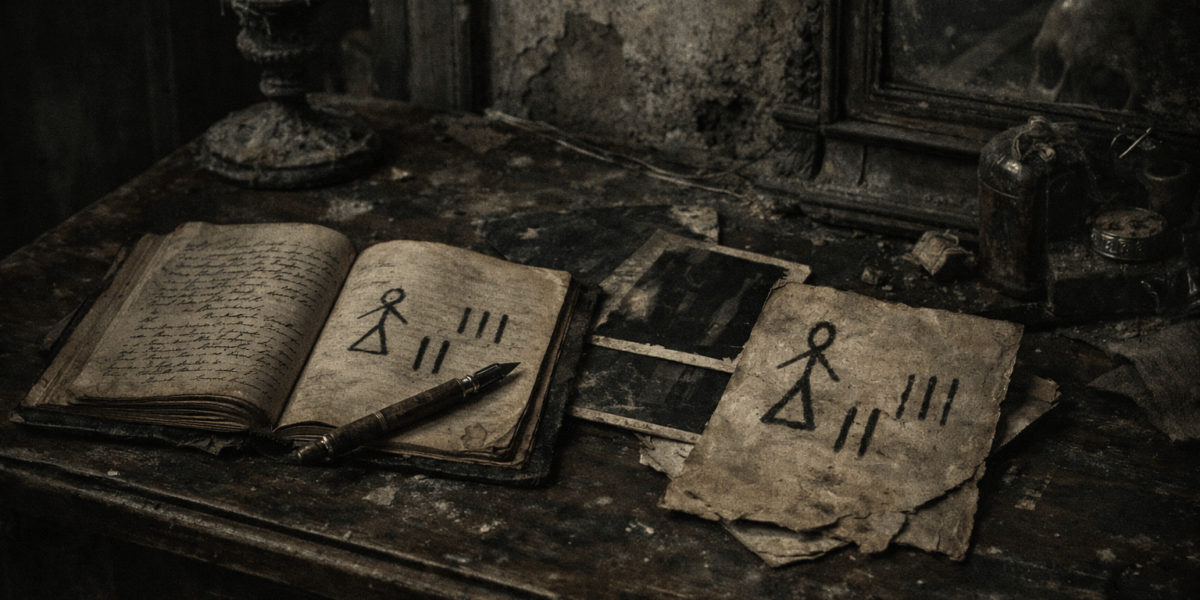
I was bagging hardware. Painter’s tape folded into little flags: north closet hinge, bath transom latch, pantry striker. Taped to zipper bags, lined in a row on the stair. I have always labeled things, but tonight I noticed the way I write arrows. A thin shaft, a tight triangle at the point, no tail. I saw the same arrow, faint and smudged, on the underside of the landing tread when I pulled it earlier—pointing to a shim that had long since crushed flat. The pencil is almost a grease shadow now, but the hand in it is assured and quick. I made the same mark on a ceiling beam at noon to show where the cable run should cross. I didn’t think about it then.
On the exposed stud by the bathroom door, there’s a measurement written in a cramped hand: 31 1/4, then the fraction circled. Below it, another hand—mine—wrote 31 1/4 again, weeks later, with a question mark and then crossed it out. There are small notches cut at the exact height of an old rail that I removed. I caught myself making the same notches this afternoon to register a temporary brace. The knife went into the wood at the same angle. When I sanded the paint back from a hinge mortise, I found two small ticks chiseled into the jamb where the leaf once sat, a code to remember orientation. I use the same ticks without thinking. Habit, I told myself, a tradesman’s shorthand even if I’m not a tradesman.
Near the stair stringer, low and almost invisible unless the light hits it, somebody took a nail and scratched two letters into the paint and wood: S.B. The head of the nail left a tiny comet tail in one stroke. It isn’t recent. Paint has flowed into the cuts and lifted out over years of seasons. I brushed dust off it and then put the brush away and left it there. I don’t know the person. The initials felt less like a signature than a small proof: someone stood in the same square of floor and decided that mark was necessary.
I keep finding these proofs. The little jar of screws in the crawl, sorted by length and head. The string tied around a loose outlet box so it wouldn’t slip back into the wall while someone worked—knot tied left-handed, same as mine. A scrap of graph paper used as a shim behind casing, trimmed exactly along a square. The decisions are not romantic, not gestures. They’re solutions that happen to rhyme.
I used to think persistence was a virtue I chose. It reads better that way. But the house rewards it and punishes its absence with a patience that feels like pressure. Doors bind only if you let them almost fit. Floor squeaks only if you accept the first fix. The slant you can live with becomes the slant that will move your table every day until you correct it. The problems are ordinary and exacting, and they pull you into a certain posture: measuring again, marking lightly, returning at night to see if the shim held after the wood cooled. You fall into it or you leave.
This isn’t flattery. Kinship is not a compliment if it happens at the level where you don’t choose. The thought that a house could select for a temperament—that it keeps, by attrition, people wired a certain way—seems dramatic when written out, but the evidence isn’t loud, only consistent. I see a personality shape repeated in pencil and knife. It looks like mine, or rather, mine looks like it when I’m here.
Resemblance is most unnerving where one has not attempted it.
— Thomas Hale