
Entry #101
January 27, 2025 — 9:45 PM
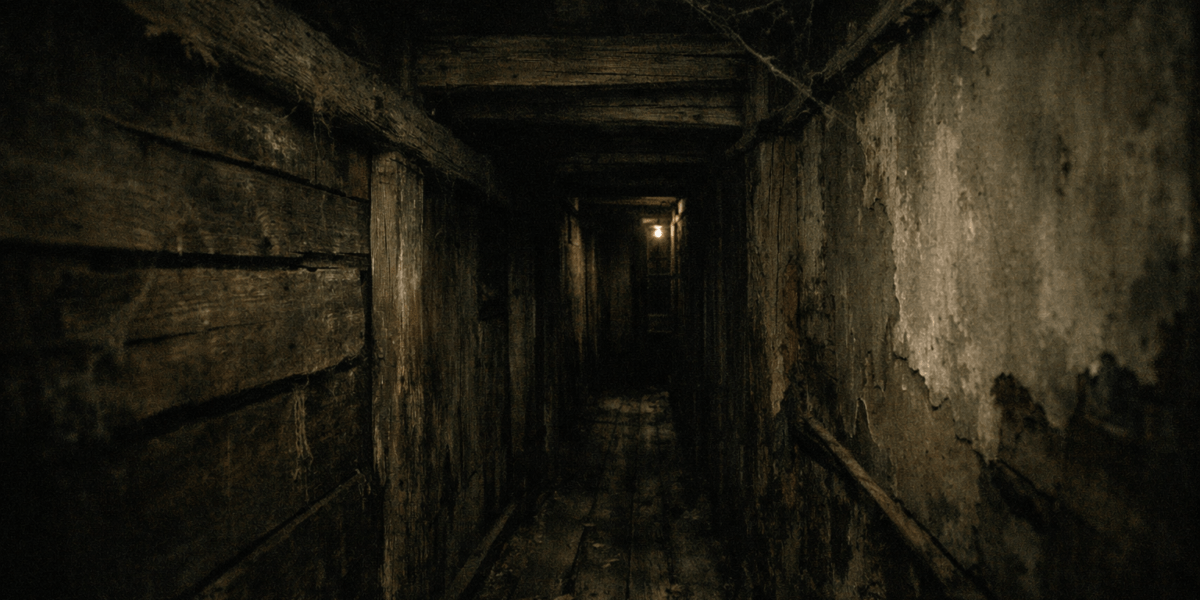
I stepped through just after first light and found not a cavity but another hallway, narrower than code would allow now, built the length of my shoulders plus a little. I measured: twenty-eight and a half inches wide, seven feet three inches to the underside of the joists. The floor is raw plank, never dressed for show; you can still see the saw marks running diagonal. There’s a lane of burnished wood along the right side, six inches wide, where boots or buckets favored a path. That kind of polish only comes from repetition.
The air had no draft. Dust hung level with the beam of my headlamp and didn’t go anywhere when I moved. It smells like dried resin and paper. Under that, mouse, old and not current. No sharp mildew. Cooler than the kitchen by a few degrees—enough that my hands noticed it on the knuckles.
Construction details: the interior faces are sheathed in vertical boards, tongue-and-groove, painted once a long time ago in a brown that lost its gloss. Nails are square-cut in most of the boards—older stock—while newer repairs show round-wire nails. Behind the sheathing I can see the back of the lath for the dining room wall. The keys of the plaster push through like frozen waves. Between studs, small hinged panels have been cut and closed again from this side with turn-buttons. One opens onto the chase behind the parlor register. Not decorative—just access. Purposeful.
The route makes sense of the nonsense the front house presented. It runs parallel to the so-called “true hallway” from this morning, then it kinks around a chimney mass and continues behind the built-in in the study. Someone planned it like a service spine. Hinges on the show-side doors I’ve been fighting for weeks now align with dead lengths of wall that, from in here, have simple batten doors set flush into the boarding. They lock from my side with wooden wedges. No ornament, no keyholes to betray them from the rooms.
There’s a narrow stair up. Seven-inch treads, nine-inch rise, too steep for comfort but workable. The handrail is just a rounded strip screwed into blocks. The middle of each step is softer underfoot—the old pine there has a slight cup worn into it. At the base of the stair is a bracket with a tin reflector tacked up behind it. Soot above, but not fresh. Farther along there’s knob-and-tube wiring riding porcelain spools, then a splice where someone decades later brought Romex through and fastened it with homemade cleats. Trades came through here because it was the logical way to work without tearing finished walls.
I kept numbers to keep my head steady: three steps from the first panel to the chimney break; twelve to the study; thirteen up to the mid-landing. I took photos with the tape laid in frame and made chalk arrows on the boards showing the orientation back to the kitchen. On the jamb at shoulder height, two letters scratched shallow: S and B, or maybe 5 and 8 if you don’t want to see letters. Shallow, not recent. I logged it and moved on.
This is not a sealed oubliette. It was made for feet, for hands that knew where to press. It connects heat chases, flue cleanouts, the backs of cabinets. A second logic under the visible one, practical as plumbing. I’ve been circling its outer skin since October; now I’m in the circuitry.
There’s a difference you can’t photograph. Even standing still, the air here feels held—like it hasn’t turned over with the rest of the rooms in a long time. It is not just cooler. It feels older.
— Thomas Hale