Entry #334
April 20, 2026 — 3:45 AM
This afternoon I went back through the oldest core with the quiet that followed the machine. No transformers humming now, only the small noises a house makes when it cools. The light through those sealed seams is steady and thin. Dust holds in it like silt in still water.
I traced the stations first—the little places made to hold a body and a set of eyes. The plank let-in beside the western chase, knee height, smoothed by a century of weight. The brick lip opposite the inner flue, just wide enough for a person to sit and not tip. A narrow niche behind the shear wall where your shoulders fit if you turn slightly and lower yourself. All of them face something precise.
The alignments are as deliberate as doorways. A slot in a sill that cuts the room into two sightlines; a bore through two studs that meets a hairline in the far plaster; a pencil mark at eye level that becomes a crosshair if you stand at the right chip in the mortar. Some only make sense at a specific hour. At three in the afternoon a bright seam crawled along the plaster keying and met the bore exactly; at four it had slid off the joint.
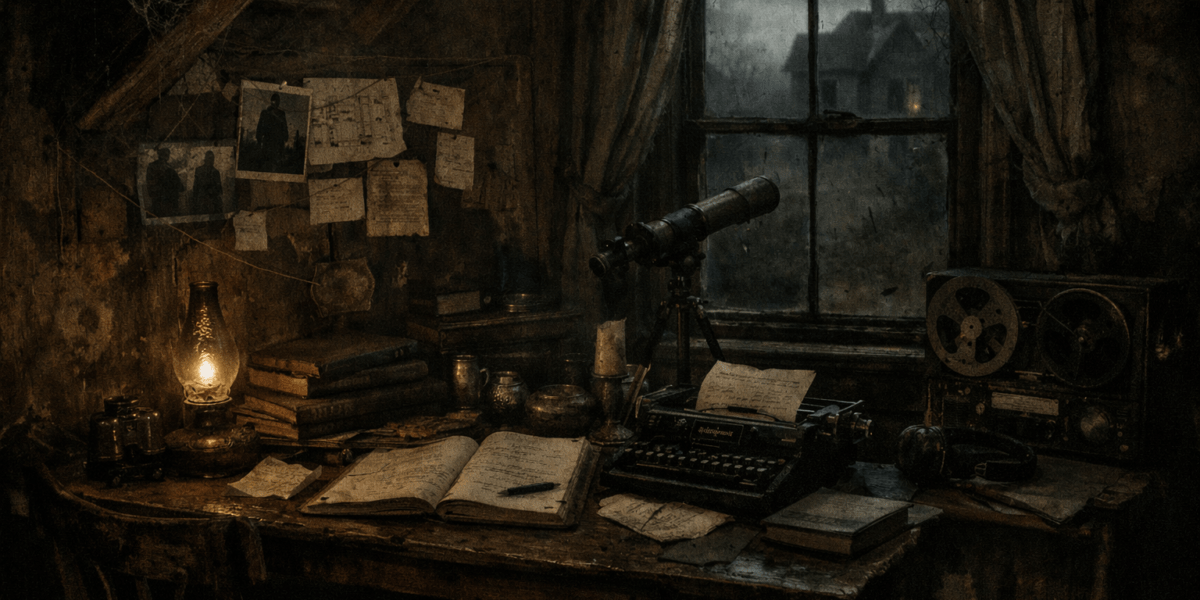
At each station there was a writing point, and not improvised ones. A ledge with a fixed pencil stub, wire-twisted so it won’t go missing. A shallow dish that once held graphite dust. Tacks driven into a stud in a rectangle where a paper would sit, four punctures in the wood softened by handling. Grease marks where a thumb would hold a page. A cut-down slate leaning behind a joist, its edge polished. In one corner, scratched over with other scratches until it was almost white, I found a faint “S B.” Elsewhere an “E—” with the tail pulled long and then abandoned. Not signatures; not announcements. Orientation marks left where a hand would naturally land to begin.
And there were the waiting places. Places without sightlines, only time. The short steps down to the capped drain where the air always feels cooler. The notch on the rim of the ash chute. A bare patch of joist where someone had counted notches in fives until the wood feathered. I stood in them and the house did not give me anything to do but hold still.
I thought before that secrecy was the engine: the ducts that carried sound away, the masks between rooms, the blind paths. I see now that the seeing and the writing were not secondary, were not conveniences pressed into gaps. They are as built-in as the chases. The original system wanted a pair of eyes at a particular height, at a particular hour, to notice a particular fall of light or tone in the pipe, and a hand to note it in the same place, again and again. The earliest carpentry and plaster carry this logic. Scribe lines on the underside of a beam run toward a peephole nobody would make in a later century. Behind a patched section of lath, an old layer with hand-cut keys shows the same slot, rougher, in the same direction. The witness-chain begins there.
I do not understand the mechanism, but I can feel the use. When I stood and looked, the alignments held steady longer, as if my attention pinned them. When I wrote, it was easier to find the next point, as if the act of recording completed a circuit. I am still not warm; I do not fog glass. But the graphite takes to my hand, and the marks I make sit alongside the old ones without resistance. I recognize my place in their continuity with a reluctance that has nothing to do with belief and everything to do with fit. I am being counted.
The house kept, and it hid. But today it read as something else: a made environment that expects to be seen and expects to be written down. I write that the house appeared to have prepared not merely for secrecy, but for testimony.
— Thomas Hale