Entry #181
February 20, 2026 — 8:30 PM
This morning I stopped pulling and started looking. New phase, same house. The tallies bothered me overnight, the way they sit on top of other intentions. I took a notebook and a knife and walked the chamber, the cellar, and the usual routes between.
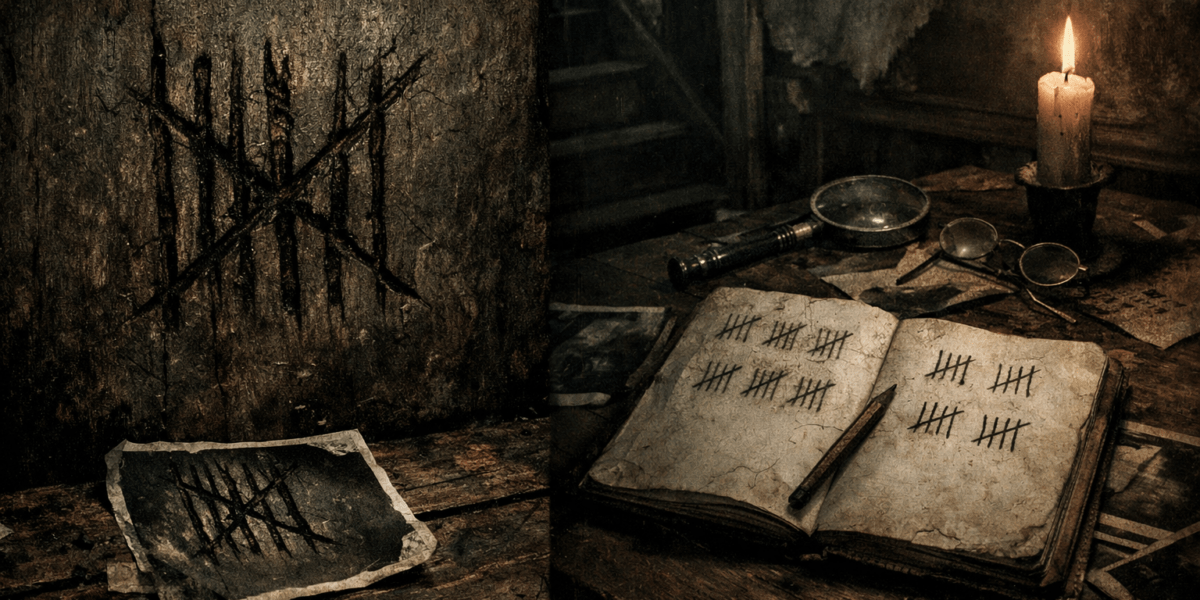
In the north chamber, the later counts are obvious: blunt pencil strokes along the plaster seam, fives crossed like fence rails, a chalk ring at the floorboard knot I’d taken as someone’s habit. I eased a loose lath with the knife and found the older work under it—two shallow chevrons carved into the stud, set apart by the width of a thumb. New pencil, old cut: the chalk circle falls exactly over the lower chevron, as if tracing it through paint and years. The tallies line up in groups that space themselves by those older chevrons. Even where the plaster is whole, I can feel the slight rise under the skin of it if I drag my knuckle along the seam. Whoever made the pencil counts did not invent the spacing. They inherited it.
The cellar was colder than usual; the lime smell sits low today, sharp in the nostrils. Along the south beam the pitch has dripped and cured like black glass. There are later notes in carpenter’s crayon—arrows, dates I recognize from renovations in the eighties, a string of numbers that match nothing I own. Under the pitch, at the beam’s lower arris, I found a run of tiny cuts: a stepped pattern, slanting steady left to right. I scraped a little with the back of the blade. The surface under is darker, not fresh, the kind of dark that comes with handling and air. The new arrows point in the same direction as that stepped run. It isn’t a translation, but it’s obedience. Farther along the beam, a different hand has added crude ticks between the old steps, trying to match a rhythm they couldn’t see.
Routes tell on people. On the stair, the underside of the banister has later pencil arrows, half-erased; at the top landing, a faint graphite X. Under the first tread, where the riser meets the stringer, I found a shallow circle incised with a split tail, so worn it lives more in sheen than groove. The pencil X above it sits squarely over that circle. And on the stringer itself, hidden under a warp of flaking varnish near the basement door jam, one word carved in taller, careful strokes: BLACKWOOD. The B and K are deep, the rest rushed but deliberate. I took a photo and sat on the concrete by the washer with cold wicking through my jeans, because the name was not an accident and not recent.
At lunch I tried county records again. The search engines return furniture stores and an old lumber company advertisement, no family here. The physical deed I have mentions no first names on the visible page. I called the clerk; she asked me to come in person if I wanted to chase ghosts in the ledgers. I told her I was chasing boards. I learned nothing new, which is its own note in the margin.
Back upstairs, I traced the pencil tallies lightly with a dull carpenter’s pencil to map their spacing. The more I followed them, the more the older language surfaced—less like numbers, more like tools: wedges, stops, hinges in the grain. The earliest marks reduce to strokes that don’t choose letters. The later hands try to talk in numerals and arrows and end up pointing where the house was already pointing.
I can’t read it, not cleanly. But the continuity is there to the touch. Imitation is often the surest evidence of earlier authority.
— Thomas Hale