
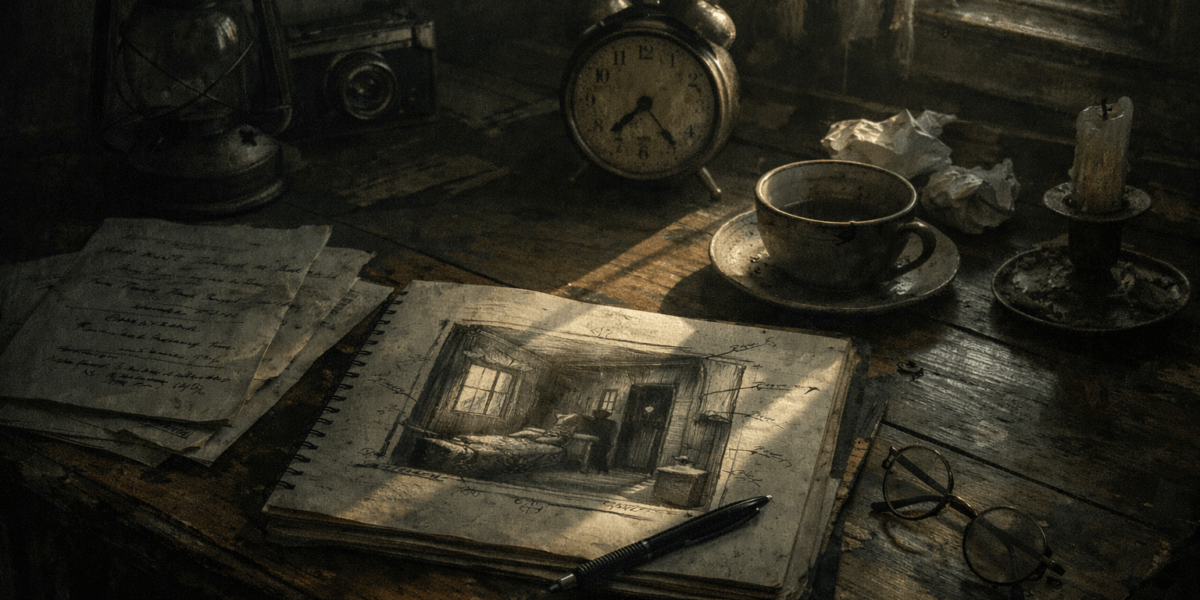
Entry #91
December 7, 2024 — 11:45 AM
I am recording positions. Second floor hall. The run that faces south, then turns west at the narrow outside corner I called the bend yesterday. I stood with my right heel on the long seam in the old oak boards where a strip was patched, 14 inches east of the corner. Left foot forward by one board’s width. Right shoulder 6 inches off the east wall. Eye height approximately 68 inches. I put two short pieces of blue tape at my heels and one at shoulder height to mark contact points. A pencil arrow on the tape shows my gaze line.
Time of first sighting today: 9:12 AM, confirmed by the phone log I checked after. Weather: overcast with thin breaks. No leaves left on the maples, so shadow movement is minimal. Furnace off (thermostat shows 59°F), no fan. The south bedroom door was open 50 degrees. The window there has a white drop cloth taped inside as a paint shield; it diffuses the light. Phone lux app at the bend reads between 220 and 310 lux, fluctuating when a cloud edge passes. The west-facing room door at the far end was shut. No artificial lights on. Smell: plaster dust and primer. One ticking sound in the hot-water line at 9:19; otherwise still.
What I think I saw: a discontinuity at the outside corner, at my eye height. Less than a second. It read as an oval darker than the wall, where the two planes meet, with a slight forward curve, then nothing. It registered as movement withdrawing toward the west run. I did not hear a step or breath. I did not feel air move on my face. The temperature at my cheek felt constant. I blinked after, not before.
Procedure after: I repeated the pass twenty times. Same foot positions each time. Walk rate controlled by a count of six from the stair top to the bend. On half the passes I turned my head only with neck rotation, no eye shift, to reduce saccade effects. On the other half I let the eyes lead. I also dragged a chalk line from the stair newel to the corner to fix a consistent sight axis. I set a string on small finish nails at that height and aligned my pupils to it, so each approach matched.
Findings: with the head kept still and eyes slow, the corner resolves as two clean planes. With a quick eye sweep, there is an instant where the brass door knob on the south bedroom, catching pale light, drops out of the peripheral field and the oval shadow it casts on the hall plaster is left behind before the brain fills the gap. That produces a shape similar to what I registered. It can be made to appear by speeding the turn and disappear by slowing. It does not account for the small forward curve I noted, but it explains most of it. I marked the knob’s angle (tape at 50°) and the sun break times (9:08–9:16) in the margin of the hall plan.
Additional: at floor level on the east baseboard, 9 inches before the corner, there is a shallow scratch under the paint. I scraped back the primer with a utility blade and found two letters, E and B, cut with a thin point. The B is deeper. I took a rubbing on thin paper and labeled it BEND–EB–12/7/24. The rubbing and a print of the tape marks go in the archive box with a note on the light and the door angle. The same goes into the ledger. The archive does not blink.
I am not relying on sensation alone. I will keep adding positions and conditions until the pattern, if there is one, stops depending on speed. The eye is a poor witness unless made to answer slowly.
— Thomas Hale