Entry #323
April 2, 2026 — 2:30 AM
The hour has that dry, clicked-closed feeling. The baseboards hold their breath. The radiator hasn’t knocked in weeks, but I still wait for it out of habit. The window over the landing shows no fog where I leaned. My shoulder made no mark. The glass is just glass, cool as a coin.
The chair from the witness positions stands where I left it, turned toward the stairwell like a lookout who won’t report. The folded towel under the parlor door never shifted. The penny on the first tread still sits with its dull edge parallel to the riser, as if set by a ruler. I pass, and nothing attends. The house keeps its exactness without me leaning on it.
The ledger is on the hall table, open where it opened last time, as if it wants a draft that no longer runs. The paper smells of paste and attic. A faint ridge under the top sheet where a nail head lives below the wood. Along the inside hinge someone long ago inked a straight line with a practiced hand. K. Hale, I wrote in a margin last night, to prove the act of writing to myself, then raised the page to the lamp and saw the stroke sit on the surface and never sink. Kept but not taken in.
I have been circling, assigning tests: glass, mirror, coin, towel, door. I have been professional about it, like a man in a lab that happens to be a house. I keep waiting for the step that changes some small thing back, a scuff that isn’t there, a print in dust that wasn’t mine yesterday but could be today. Nothing answers.
So: the fall. I put my right hand on the banister. The varnish had hairline splits that ran with the grain. I was carrying the box with the ledgers and the cheap lamp. Second-floor landing, third tread from the top of the flight down. I felt the tread bow, not crack; soft at the nose. My foot slid forward, heel caught the riser, weight went sideways. The spindle gave with a dry snap—a broom handle sound—and I swung into the open. I remember the newel post rushing up too slow, the way of it when your body cheats time for a second and then pays. Wood. Plaster. Tile. Things that don’t care about you. A ringing that did not fade so much as thicken. This is what I know and will put down plainly: there was no next breath.
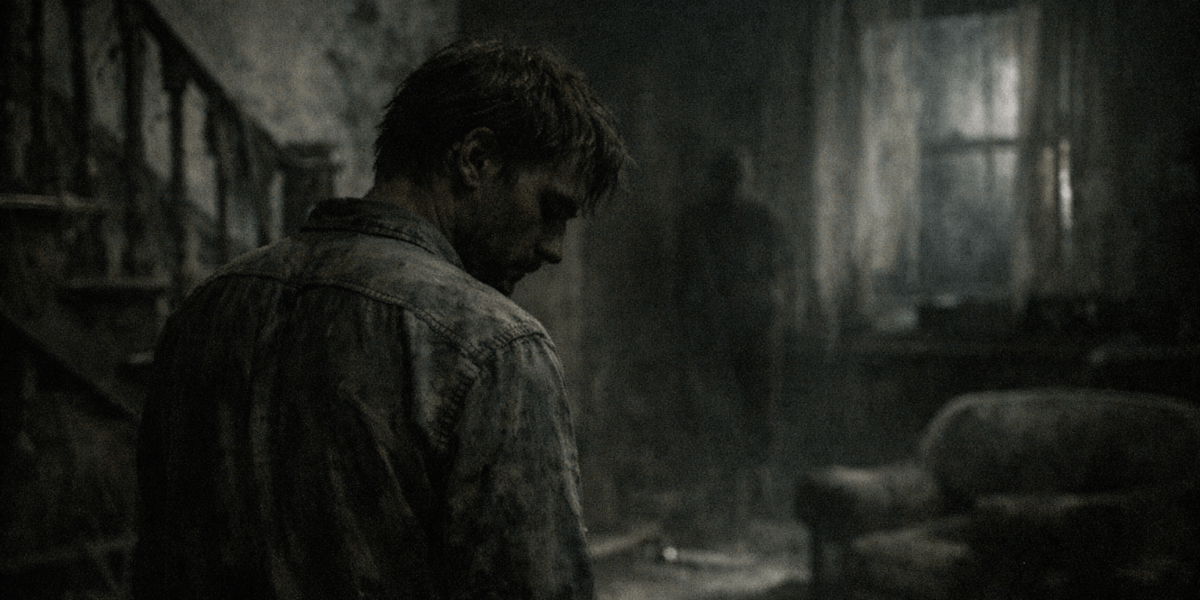
After, the geometry of the hallway would not solve back to upright. The air didn’t dim, or brighten. I waited for pain because that is a step we expect and use to count our way out of shocks. It didn’t arrive. I put my mouth near the window and nothing clouded. I pressed my palm to the banister again and felt the idea of its curve, not its heat. Under the lip of the landing, scratched into old paint, I noticed an S and the start of a B, letters I had never seen from above. They must have been there longer than my ownership papers.
It is not defiance to say it. I don’t feel like a story someone else would tell. I just stopped, and the house did not. I died in this house. The rest of it—these pages, the hours that don’t add up—are what happens when a place refuses to let go of its facts. The house did not become haunted when I died there; I only became one more fact it could keep.
— Thomas Hale