
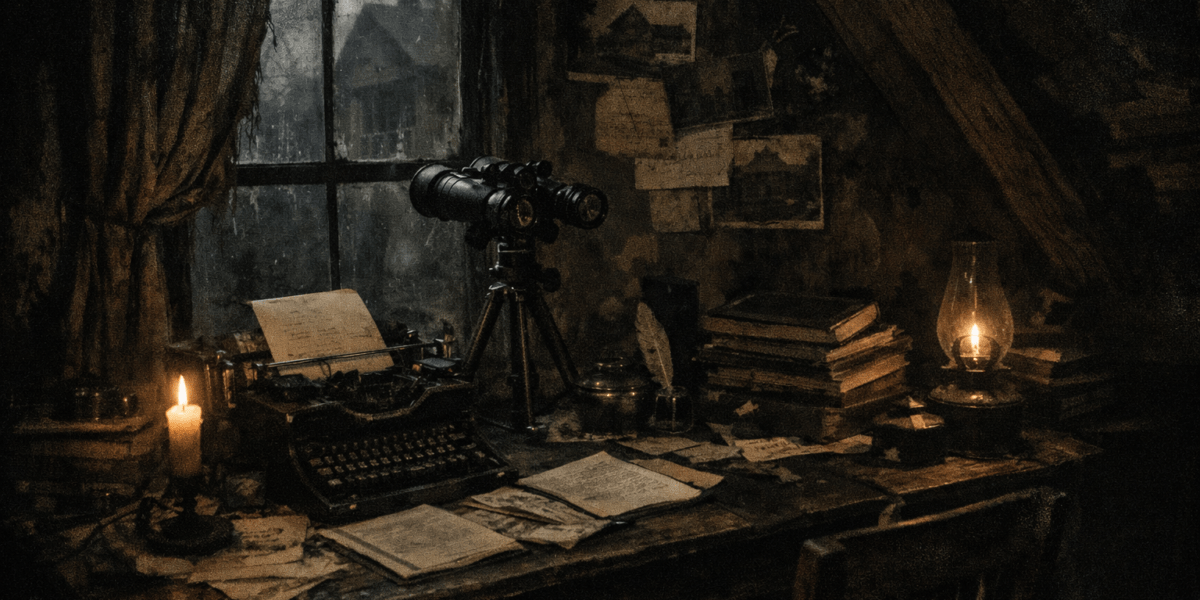
Entry #242
December 3, 2025 — 3:45 AM
I worked through the afternoon, dust in my nose and that raw plaster smell that never leaves your clothes. I had the dining room casing off and the west light coming in low, gold and flat. The frame under the trim had a shaved quarter inch along one stud, a long shallow bevel at exactly eye level if you stood with your right shoulder tucked into the corner. The wood there was smoother than the rest, as if polished by a sleeve. Above it, in pencil so faint I almost missed it, a cross and a short arrow pointing toward the parlor door seam.
It isn’t just that there are places to hide. I’m seeing places to wait. Stations. They occur like punctuation: at the turn of the back stair, the sliver beside the pantry chimney, the narrow bite behind the hall radiator. Each one has some courtesy to the body—a nick for a toe, an elbow rest, a line at the height of a patient head—and each is aligned to a gap or a reflection. Standing on the fourth stair, the one with the rounded nosing and that soft oval worn into it, you can see the pantry door hinge in the mirror over the sink if the door is left two inches ajar. I measured. Two inches exactly gives you the angle. Any more and the mirror breaks the line.
There are notations I took for carpenters’ marks that aren’t that. Tiny paired slashes at the baseboard opposite the cellar door, set twelve apart like minutes around a clock. A date fragment on the lathe under the plaster in the front hall—6/14—then a torn paper scrap glued flat by time, the ink washed but the downstroke of a B still legible beside an S. Blackwood. I have the deed copied; Samuel and Eleanor Blackwood signed it in 1891. The scrap is older paper than the wall paint around it. In the closet under the stairs, a pinhole bored through the beaded board at shoulder height. From inside, you can sight directly across the hall to where a chair would sit against the north wall. There are two nail heads set like rests where a forearm would learn the habit.
The house was not only keeping things in. It was arranging how they’d be seen. Light, line, the quiet drift of sound under a door. Standing at one station, I could hear the range hood in the kitchen even though the door was shut; the draft carried a soft metallic flutter down the stairwell. I wrote down the times when the sun lined through the dining room window and made the parlor keyhole glow: 2:18 to 2:27 PM today. When I wrote the numbers, I realized I was duplicating what’s already logged all over: crosses, ticks, little arrows to attention. My tape flags on the floor looked like a fresh layer of the same old purpose.
I keep telling myself I’m renovating. I have become, without meaning to, a recordist. The journal was supposed to be for me, for the work, for the oddnesses. It has learned to take on the shape of the house’s notes. I date, I measure, I align entries to small facts. I have been supplying it with view and time, which is exactly what these stations seem to request.
As for the Blackwoods—their names come up where the viewing points are most deliberate. S. Blackwood scratched into the back of the stair stringer, E. in graphite on a plaster key, initials curled into the dust of old varnish. If they were first here under the 1891 deed, they might have been the first to set these points and mark what they saw. Or they were the first to be set in place and marked by it. I can’t tell which way the record runs.
Today made one thing plain: the observation wasn’t incidental. It was foundational. The alignments feel like demands. My pages answer. Walking the rooms, I felt less like an intruder and more like a necessary part, filling a blank line where a witness goes. The house appeared to have prepared not merely for secrecy, but for testimony.
— Thomas Hale