Entry #187
March 18, 2026 — 2:30 AM
This afternoon I opened the service void behind the pantry wall, following the line I marked yesterday. The light in there goes flat and chalky. Dust dulls the beam so it looks like weather hanging in a box. The cold had a tight feel, like a kept cellar.
The first thing that caught me was a run of screw heads in the framing brace. Every other one had its slot turned vertical, then the next horizontal, then vertical again—precise, like some person had decided the rhythm mattered and then insisted on breaking it. The tips behind were bent, too. Not the mushrooming you get when a novice overdrives into hard grain, but a deliberate curl with the claw hammer, teeth marks shallow and neat.
In the next stud bay, a slim copper strap that should have been looping around the conduit was cut an inch short and folded back on itself. The cut edge was sharp, bright under the tarnish, not the ragged oxidation of a snap gone long ago. Someone had trimmed it to keep it from meeting. A shim of card—old, brown, smelled faintly of oil—was wedged in the gap where the strap would have kissed the pipe. On the card, a hand had written something, then crossed it until the ink burred the fibers. I could make out only “keep” and a loop that might have been a lowercase b or an h. The crossing out was furious but contained, a hard X repeated until it wasn’t a letter anymore.
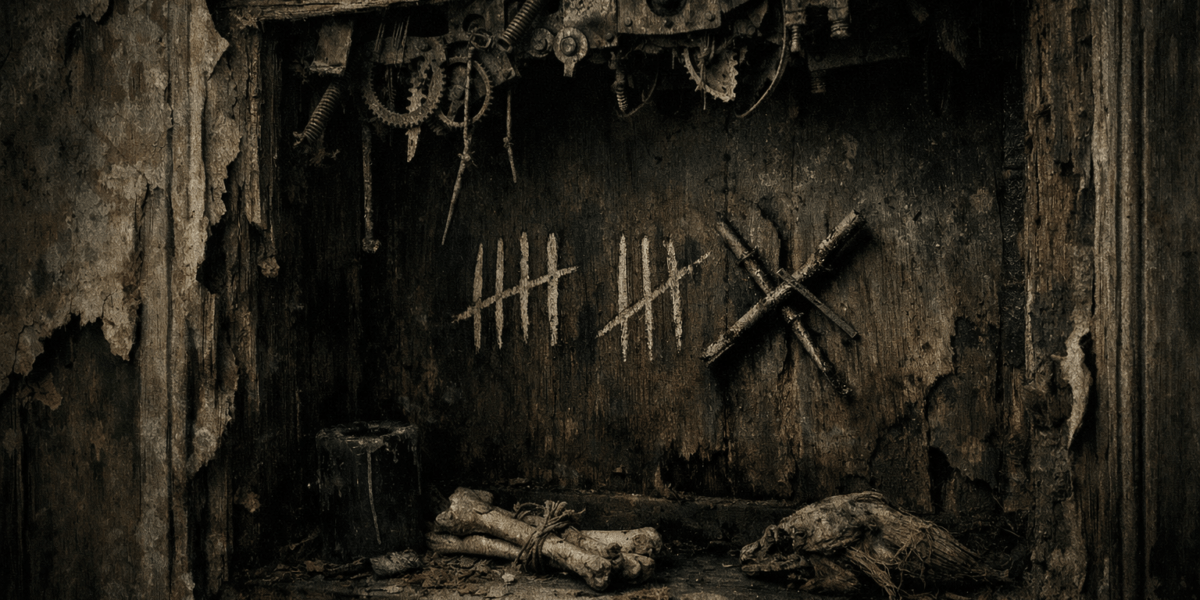
I found other misfits. A hinge plate inside the closet chase that never sees daylight: its holes elongated with a rat-tail file, the screws reset off-center. A small brass pin that would have kept two thin slats aligned under the stairs—missing, and the hole plugged with a toothpick snipped clean and flush. On a length of lath, a line of tally marks I’ve been seeing elsewhere had been scored, but here every fifth mark was sanded nearly away, the ghost of it left like a scab someone picked too soon.
Under the third tread, where I pulled the riser to trace the squeak, there was a linen tag tacked to the stringer. The thread was gone to dust, but the tag held, stuck by old varnish. Faded ink, stamped letters, uneven as if the stamp wasn’t seated flat: BLACKWOOD. I pried it off with a putty knife and set it on the step. The heat of my hand brought a sour, paper smell. I went to the county site after dinner, then the registrar’s scans. I can confirm the deed date—I’d seen that—June 14, 1891, Samuel and Eleanor Blackwood listed as grantees. Births and deaths? Nothing. No mortgages in their names. No probate. The name feels present and absent at once, like the missed screw or the cut strap: a deliberate gap.
There was a note behind a switch plate in the front hall, folded tight as if to stay. On the outside: a small circle in pencil with a notch at the north. Inside: a set of arrows and short words, then all of it crossed hard and again. One line read “repeat at four,” then a torn corner where the rest should have been. If this was a routine, someone wanted it interrupted.
I am slow to assign intent, but the marks fit. The edges are too clean, the breaks too consistent. It isn’t rot or impatience. It is a hand applying pressure in the wrong direction on purpose. In some places the house answers by settling a new way—the stair I tightened groaned somewhere else tonight, a different timber taking the load. There’s no victory in that; only a map of small collisions.
Not all of the people before me followed along. Someone took the time to cut short, to misalign, to plug, to cross out. I recognize the kind of work that refuses without announcing itself. Some of the repairs in the hidden house had the look not of maintenance, but refusal.
— Thomas Hale