
Entry #339
May 3, 2026 — 3:45 AM
This afternoon I walked the rooms again and listed the places that press on me in a way ordinary age does not. I do not mean the soft parts of memory. After death, weight has changed its units. A hinge can lean on you. A corner can load the air. I wrote down the objects and spaces that carry the most pressure, then went back to check that the feeling matched the facts.
Pantry first. The latch and hasp are on the corridor side, not inside. The strike plate is chewed with repeats of the same key, same angle. Shelves have double grooves where a scale’s feet sat long enough to bite. The scrubbed top board is smooth except for one patch, a square the size of a ledger book, less worn like it was always under a hand. Vinegar in the seams, mouse dirt in the toe-kick, but the current in there is not about food. The door closes and the air thickens by half a degree I cannot measure with skin, only by its drag.
The small room at the top of the back stairs: bolts mounted to the hall. Keyhole reversed. A wooden bar on the inside of the shutter, but the bar is split and painted in place. Window opens less than two fingers. The floor pitches so anything round rolls to the far wall where the baseboard has three iron staples set low, with shallow nicks where something taut sawed paint from them. The whitewash has fingernail crescents at knee height. On the underside of the sill: E scratched over itself until the letter furrows. No surname. Afternoon sun made a rectangle on the floor and the rectangle felt heavier than the room.
Cellar. Three more staples sunk in the main beam, factory-made not ornamental. The packed dirt has two settled troughs parallel, shin-width apart, in front of them. There’s a clay sump near the wall with a brick collar and a discolored fan in the earth pointing to it, like water or something else ran that way many times. The iron smell is old but does not lift. When I stand beneath the beam the air flattens, a steady downward, like standing under a low bridge before a train.
The hall by the stair. Newel post has a dull oval, head-height for a child, shoulder-height for me: the same turn taken too many times. The top of the rail is abraded to bare wood along one arm-length stretch, not where a hand would travel but where a rope might have dragged over and back. Under the fourth tread the line still stays where it stayed, pinched behind a split. I cannot loosen it. The pressure there is quieter than the cellar but older. It feels decided.
Front room that pretends to be polite. The wallpaper is newer but the studs behind it knock denser on the north wall, as if the cavity is choked. There’s a drilled hole behind the crown molding that looks like a vent but opens toward the adjoining room’s transom. The desk has twin dark rings from inkwells and the bottom drawer faceplate is newer brass, two extra screw holes below the current ones. Floorboards have a hollow where a person would stand facing the hearth, not the chair. The smell is lamp oil and old soap. The air is warm here, and the warmth is not comfort.
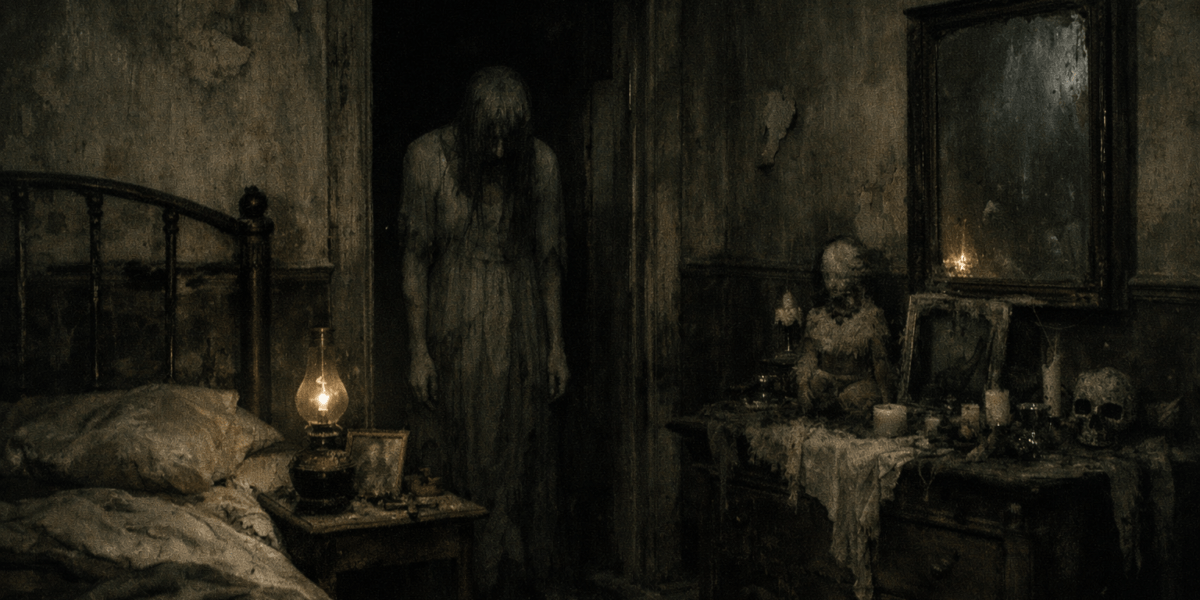
Master bedroom door: the hook-and-eye is on the outside jamb. The strike shows three sets of holes, moved inward twice. On the inside of the door, a small patch where an eyelet once was, filled with darker putty. The threshold is higher than the other rooms. Someone planed the bottom of the door, not the wood beneath it. On the bed slat, underside, the letter S. Just the one.
These are not ghosts. They are uses. They are choices fixed into wood and iron. Put together, they suggest an origin built on compliance, not shelter. I do not know the names yet. I know the pressures. Some rooms retain temperature, and others retain verdict.
— Thomas Hale