Entry #358
June 19, 2026 — 2:30 AM
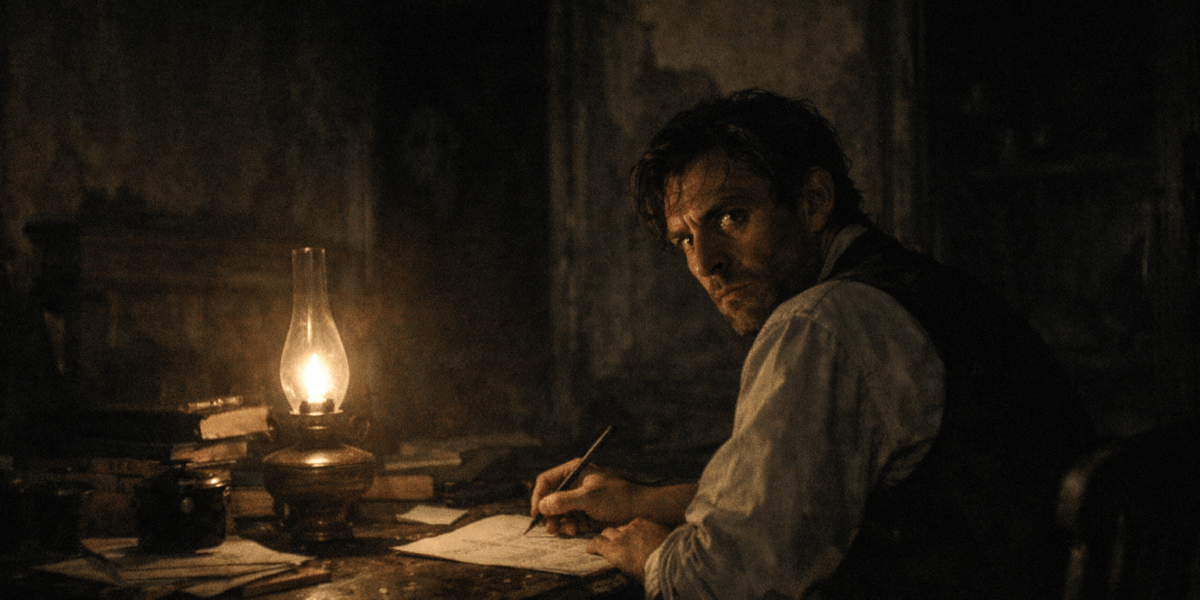
The room is still and colder than the hallway. Paper has a temperature if you wait long enough with your hand on it. This sheet is cool at first, then it keeps something of the warmth from my fingers even though I have none to spare. The nib ticks faintly at the start of each stroke, a rasp that feels louder than the quiet deserves. Dust moves only when I lift my arm. The lamp glass shows no fog, only my own shade overlapping the corner of the desk where the varnish is crazed and worn down to a pale core.
I’ve said before that the journal keeps my outline. Counting the hours, arranging what I saw and heard into a grid the house cannot immediately rearrange. It works, in the way a knot works: tension redistributed, slack stolen from one place to spare another. But tonight the page is not the blank it wants me to trust. When I tilt it against the lamp, there are ridges already pressed into the grain. Not mine. Lines no one bothered to ink, sitting like pale cartography underneath. My hand falls into them without meaning to, as if a riverbed were already cut beneath the water.
Under the blotter I found a scatter of flakes, black as tea scum. When wetted between two drops from the washbasin they bled brown like iron gall. I can smell it when I write certain loops: a tannin bite, almost like old apples and rust. At those words my wrist pauses by itself. Letters want to close a certain way—an E with a stern backbone, a W whose middle point hangs lower. Once, before I caught it, I wrote wood when I meant would. The extra o declared itself and sat there, unembarrassed. Under the page, through the desk, there is the memory of someone practicing the same mistake until it became the only form the hand could make. I don’t have to hear their names for the habit to move through me.
I tried shading a margin with pencil. The ghosts of past pressure gathered into a light dust of language. Not a full sentence—just the beginning of one and the tail of another. An S stranded near the edge, then a bar and a curve that could be a B, or something that wants me to think so. The grain in the desktop takes those marks like grooves in a record. It would be easy to call that comfort: others before me, kept. But that is the part I don’t want to say out loud, because being kept is the argument of the house.
Writing back at it feels like leverage. I can catch its shifts on the page, stake them with a date, narrow what it can claim by naming it. Yet every word is a handle as well. Handles are for pulling. If the house needs purchase to work a thing, can it borrow mine? I imagine my sentences as pegs driven into a cliff face I’m trying to climb, and at the same time as pegs the cliff will later use to pull me back down. Evidence cuts both ways. Silence has been one of its methods—rooms that swallow what was said until the person who said it is functionally gone. But what if record is another of its methods, a lattice it grows along, using the very straightness of the trellis to become stronger?
There is trouble in authorship I didn’t see at the start. This ledger might guide the next retained witness to the safer treads, might keep them from the soft boards I fell through. It might also bring their feet exactly where mine landed, simply because the path is mapped and the boot prints are familiar. To mark these pages is to make an invitation and a warning in the same act. I could resolve not to write, but I have already learned what happens when I let the margins go white: I thin, and the house gets to tell me back to myself in its voice. I’m not mistaking this. I cannot stop. I can only write with suspicion of the writing.
So I test new habits. I leave certain names incomplete. I write some items out of order and keep the key in my head. I don’t trust code; it loves codes. But misalignment feels like a way to keep a sliver for myself. Even in that I can hear the other hand’s patience, the practiced corners, waiting for me to rejoin the old groove. They are not gone, the ones before. They keep a pressure on the nib when I pass their marks, not cruel, just steady.
Tonight I accept that what has been my most faithful tool might also be among the house’s preferred instruments.
— Thomas Hale