
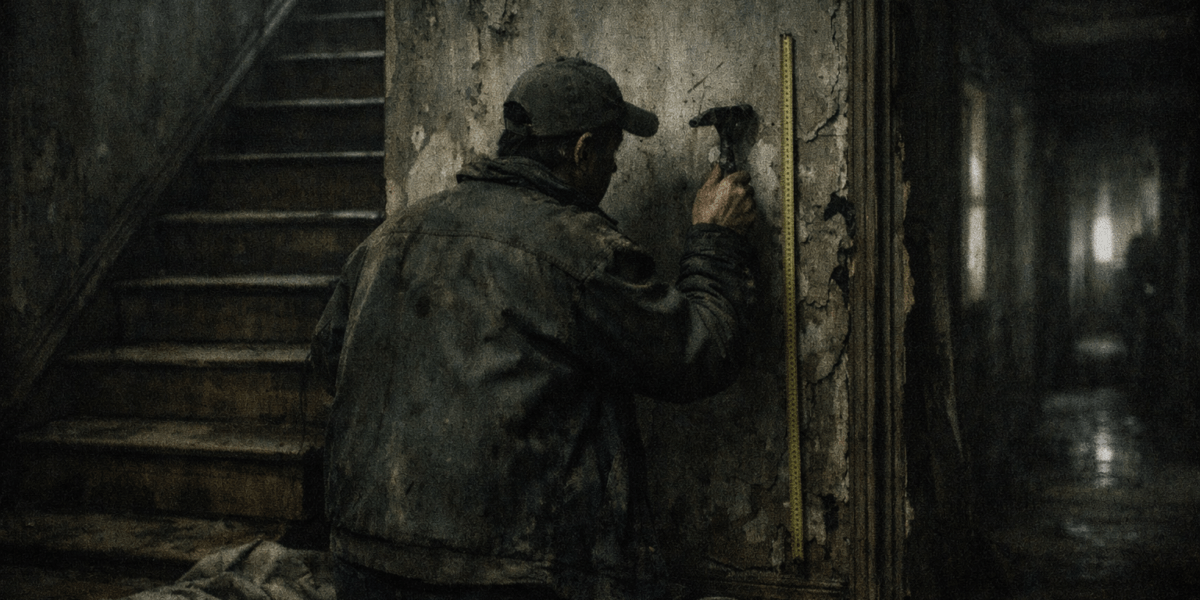
Entry #33
January 22, 2024 — 7:15 AM
Rain yesterday got into everything. The radiators clicked and breathed, glass sweating, the whole place damp at the edges. I spread the floor plan again on the dining table and started over from zero, pulling the tape while the gutters hissed. Outside measurement on the east side, corner to chimney face: seventeen feet, six. Inside from the parlor’s plaster to the hall’s opposite wall: sixteen, four and a half. I subtracted for plaster, lath, baseboards, the chimney thickness. That still leaves inches I can’t account for. Not three-sixteenths anymore. More like a hand’s breadth you could lose a book in.
I went room to room tapping like a fool. Knuckles to plaster, then the heel of a screwdriver. Along the shared wall between parlor and hall the tone changes in the middle third. Solid, then a soft drum that dies shallow. No seam, no hairline in the paint. The baseboard runs unbroken, miters clean. I looked for witness marks where a door might have been—old hinge ghosts, patched jamb mortises—but the grain reads straight through the paint. Someone sanded old knots smooth a lifetime ago and never cut them again.
Under the stairs, the little cupboard with beadboard lining. I’ve always disliked how the back of it answers. I cleared the paint cans and pressed my ear to the boards. Hollow-sounding, but not empty. More like something packed behind—bracing, or filled stud bays. The screws are slots, heads blunted by paint until they’re part of the surface. No hinge scallop, no panel line. If there’s a door there, it isn’t meant to be opened from this side.
Between showers I crawled under the house. Damp clay, cool on my palms. Webs caught the light off my headlamp and shook with every move. The joists are old pine, knife-scribed. In one bay along the east foundation, a low brick curtain wall runs between piers where I expected air. It isn’t on my plan. It lines up roughly with that soft part of the parlor wall, but there’s no opening through it, just old mortar and a shallow vent choked with leaves. I measured from the sill to the inside face of that brick and then back up top. The numbers argue with the rooms.
I tried the easy openings—outlet covers, an old telephone plate. Behind them, lath and keys like stalactites of plaster. In one box a faint cool thread of air came through the paint, carrying the smell of old dust and sap, but the chase is choked with timber. I slid a thin ruler along the floor under the baseboard where the quarter-round gapped from the settling. It stopped against something hard before the wall—brick nogging, most likely. Good for mass, bad for answers.
It’s reasonable at this point to think there’s space in the walls that isn’t part of any room. Houses from this age have chases, backings, closeted corners that work like blind pockets. On paper, though, this house keeps more than its share. I can trace it with numbers, I can hear it with my hand, but I can’t find a clean way in that doesn’t mean cutting blind into something I might regret.
Every old house has dead space, but this one seems to protect it.
— Thomas Hale