Entry #42
March 24, 2024 — 9:45 PM
I pulled the ladder under the hall hatch and stood there longer than I meant to, listening. The stairwell keeps its own low tone at night. The cellar draws cool and slow. Above the plaster, the air felt stalled, as if the heat from the day never found a way out.
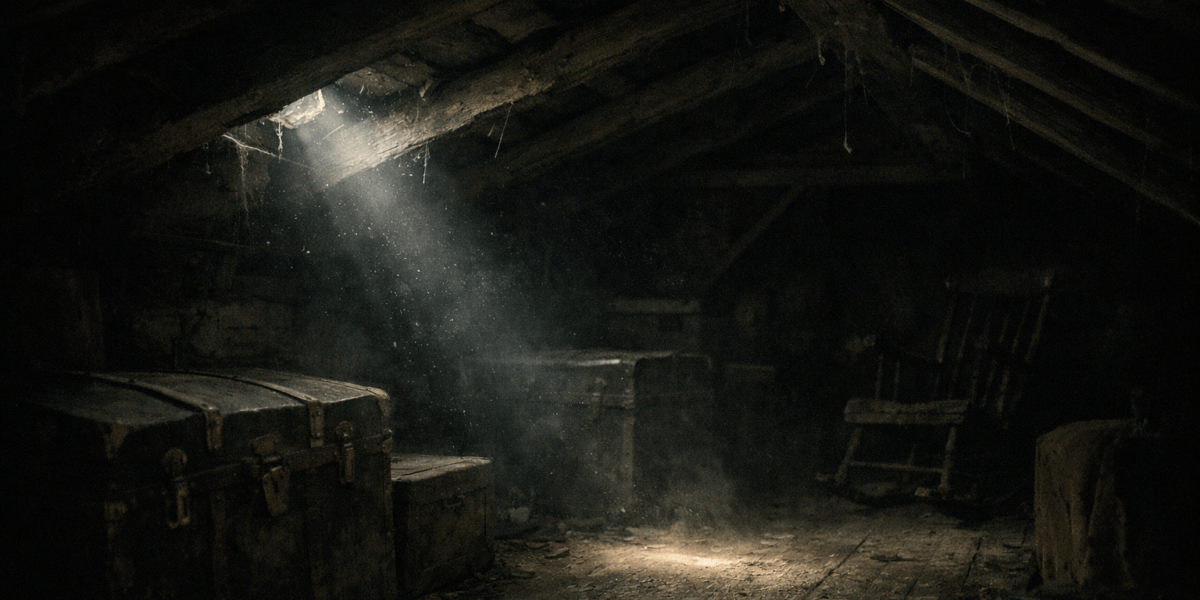
The hatch cover stuck, paint sealing paint. When it gave, a cuff of gray dust came down onto my sleeves. Warmth followed, heavier than I expected for March. It smelled like old paper, hot pine, the faint ammonia of mice you can never completely get rid of. I put on the respirator and clicked on the headlamp and went up.
There isn’t much room. Rafters close in over a skin of roof boards, nails pushed through them, rusted points like scattered stars you don’t want to touch. The joists are narrow and set far apart for feet; the plaster below needs me not to miss. Between them: a drifted field of gray cellulose, a few pink batts ragged at the edges where someone had crawled before me. My jeans picked up the itch anyway. The beam nearest the hatch had a split that had been sistered sometime in the seventies, by the look of the bolts. The temperature up there had a thickness to it, the way it lies on your skin without motion.
I tested the first joist with my weight and shuffled in, palms on rough wood. The headlamp threw a tight cone that made the rest of the attic a dark cutout; it swallowed the light instead of reflecting it. Toward the gable I could make out a screen half-covered in brown paper wasp cells and a corner of torn hardware cloth. No night breeze came in. Outside, everything was still. Inside, my own movements made the only sound at first—insulation faintly hissing as it settled where my knee brushed it, the resin creak of a board somewhere adjusting to me.
Then something else. Ahead and a little to the left, the top layer of dust over the cellulose rose and slid in a shallow line, the way you see a small animal’s wake in tall grass but without anything cutting it. It moved maybe a foot and stopped. I held still. My skin told me nothing: no draft on my wrist, no change at the vents. The beam under my hand did not move. In the second before I wrote it off as delayed settling from my crawl, the line lifted again in the same place and went the other way, short and clean, then fell flat. It was quiet enough to hear my own breath through the filter. A click came from the ridge—wood cooling, maybe—but it was met an instant later by another click near the hatch where no ridge tied in, like an answer from less wood than should answer back.
Close to my face, on the underside of a rafter, shallow knife marks caught the light. An E carved with the angled bar wrong, then a B, or it could have been an 8 started and abandoned. The cuts were old; dust had settled into them. I touched the groove and the grit came away blacker than the rest, like it had held soot sometime. I did not linger on it.
Something fine sifted from above—a dry pepper of grit on my neck. A nail head quivered in the roof board and stilled. I flashed the light along the deck, across seams and knot eyes, and saw nothing move. The heat pressed more closely. The lamp’s beam looked strangled by it. I had plywood in the truck I could use to bridge the spans, and I didn’t have it laid. I had twenty minutes of headlamp left. The plaster below didn’t deserve my misstep.
I backed out the way I came. The hall air felt usable again. I told myself the attic can wait until I have better light.
— Thomas Hale