
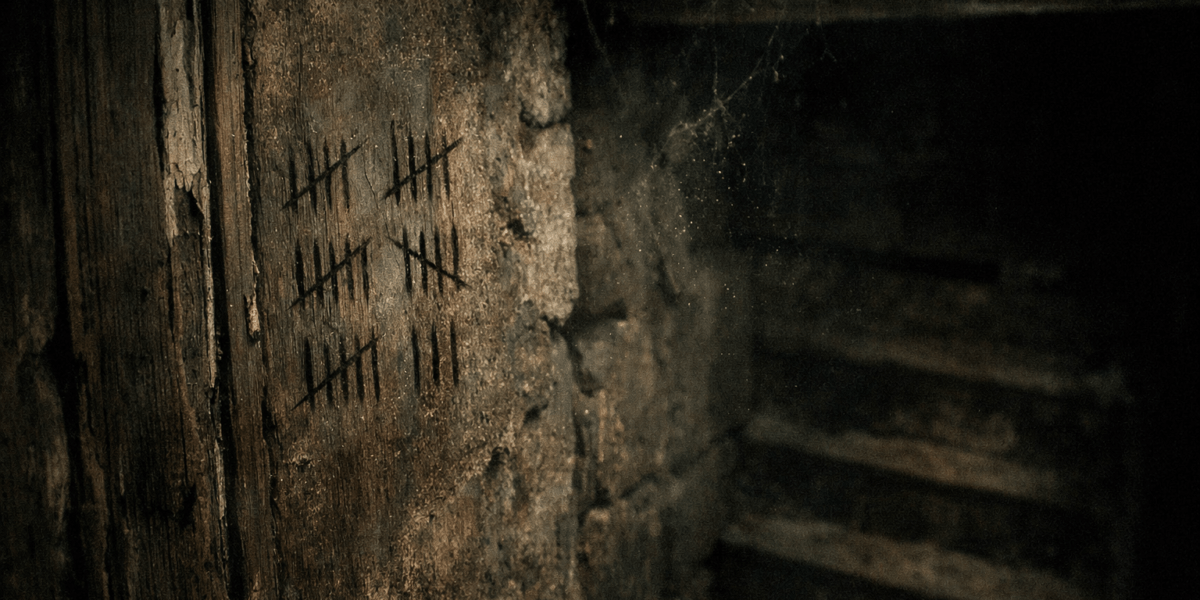
Entry #41
March 17, 2024 — 8:30 PM
Afternoon work bled into dusk. I pulled the shoe molding in the back hall and planed high spots where the floor meets the old door jamb. The shavings came up in long translucent curls that carried that dry, sweet smell of pine the newer lumber can’t fake. With the light low and raking, surface things made themselves visible.
There are sets of cuts everywhere if I let my eyes settle. I used to read them as incidental — the jitter of a careless scraper, the teeth of a saw set down wrong. Today I started lining them up in my head. Under the second stair tread: five short vertical scratches with a sixth drawn across them, slightly canted. Pantry baseboard, south wall, low and near the corner: four verticals, the fifth missing or worn, but the scars have the same rightward lean. Inside the closet door, waist-high on the hinge side: three thin lines in soft arcs with a heavier knife mark striking through them at a familiar angle. In the back hall, just above the floor where the paint puckered after last week’s leak, a set of five again, the top cross stroke almost hesitant as if the blade was lifted early.
I took rubbings with a soft pencil and paper from the notepad I keep in my shirt pocket. The graphite found the hollows and ignored the rest. Even with the variations in depth from wear, the spacing holds. The uprights sit about a thumb’s width apart, slightly closer than true uniformity; the cross strikes touch the third line more often than the second. The lean is almost identical: ten, maybe fifteen degrees forward if I had a protractor handy. I tried to measure with my tape. Seven-eighths between uprights on two examples, a hair less on the third. Same hand, or at least the same habit.
There’s age in them that isn’t mine. In the pantry, the tallies continue under the edge of a paint layer I know I put down in December — which means I didn’t see them then. The ones under the stair stringer carry old paint in the troughs, ivory and brittle, the way the original trim paint looks when it splits. One set in the hall sits beneath a smear of browned paste that I recognized when I scraped at it: wallpaper glue. Whatever counted here happened before the last papering, which the upstairs closet still records in its patterns of faded vines.
Function is the question. Tallying of days makes a neat story, but the positions don’t respect human reach or visibility. Sequence for installation has logic — carpenters marking order or placement for boards — but these show up on finished faces, where you wouldn’t usually leave layout marks. Placement for something else, then. Studs? But the spacing ignores the framing rhythm. Inventory? The sets are rarely complete, never a clean set of five, sometimes only the cross. I caught myself numbering them on the rubbings, writing the room and wall and height. It helped, and it didn’t.
Near the pantry set, very faint, two letters: an E scratched shallow, and what could be a B pressed harder, edges furred up where the grain resisted. They could be the start of anything, or nothing. They face the room as if meant to be seen and then covered anyway.
I don’t like coincidence when it organizes itself this neatly. Marks left by accident are usually sloppy, varied, and they disappear as fast as they’re made. These repeat. The hand remembers. The blade returns to the same angle as if told to.
Accidental marks do not usually recur with such composure.
— Thomas Hale