Entry #292
February 19, 2026 — 1:00 AM
I need sleep. Tomorrow is ladders and the upper south gable. Fascia, flashing, the first lengths of new gutter. I checked the weather twice, rewound the line, counted the anchors. My hands still smell like chalk from marking the rafters earlier. A little gypsum grit is stuck in the back of my throat. It would be good to close my eyes and wake with steady hands. The house has other plans.
It started with the radiator tick. It always does—a slow metal pulse that should fade as the heat evens, except it doesn’t. It keeps finding a pattern and then insisting on it: tick, tick-tick; tick, tick-tick. The downspout joins in, a wet hollow knock somewhere above the eave where ice broke loose and jammed. A length of wind slides along the soffit seam, and the seam answers. Not quite words, but it gathers into something that feels like the undersides of words. el—nor—el—nor, like a hinge catching and releasing. I know what wind does to old cavities. Still, it sits in the ear like wrong language.
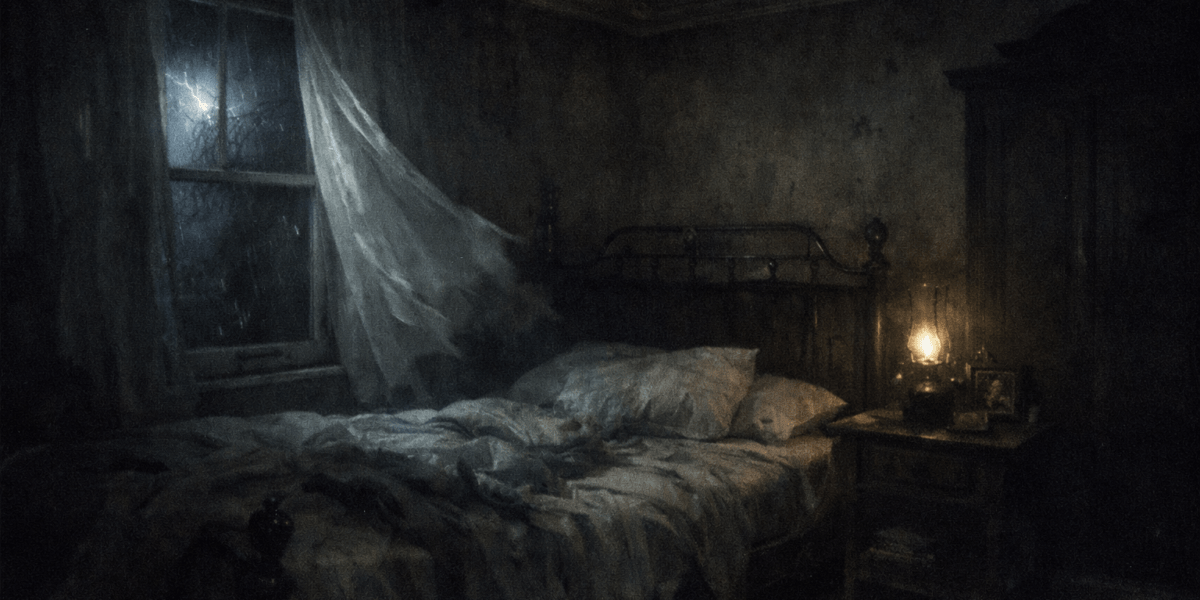
The bedroom is a colder kind of dark tonight. The plastic I stapled over the sash breathes in and out with the gusts, a light drumhead sound. The floorboards under the window sound like they’re lifting, not in motion but in decision. When the heat cuts, there’s a shallow rasp in the hall vent like someone testing their voice. It’s just air changing lanes in a tin throat. I repeat that and keep repeating it.
The house tends to raise its voice when I’m about to climb. I noticed the pattern months ago. The night before I jacked the beam, all I could hear was the slow grind in the crawlspace. The night before I opened the west wall, the bathroom door kept breathing around the latch. Tonight has that same refusal. Every time I set down the thought of height, something in the walls tugs at it.
I got up once to check the attic hatch. The string lay straight. No dust disturbed around the cutout, just the pale scatter from this afternoon and the print of my palm where I braced to staple. On the drywall beside the hatch, my chalk X is there but thinner than I remember, like it rubbed itself down without help. There’s a faint scoring near the joist end—S and a half-formed second letter. Old carpenters mark; I tell myself that. The air under the hatch mouth was colder by a degree you could taste. Raw wood and old tar, the dry mineral of blown-in insulation. Nothing moved, but the cold pressed as if something large had recently displaced it.
Back in bed, the murmuring came right through the pillow, bone-conducted. I tried earplugs. All they did was push the floor into my skull: a soft three-step thud as the house settled, the sigh in the wall cavity opening a little seam. The vent’s syllables kept arranging and unraveling. el—, then nothing, then nor—, then only the hollow of the word without a word. Not language, but near enough to keep the mind fastening hooks to it.
I keep running the measures in my head—standoff distance, tie spacing, pitch, foot angle. All this instead of sleep. Fatigue makes clumsy choices. It’s no sin to admit it. I should postpone, but the rot won’t wait and the weather turns again on Sunday. The house won’t give me quiet to think it through. At a certain hour, the rooms feel like they lean toward you, not in threat, just in attention you don’t want.
A house becomes dangerous in a new way once morning requires height.
— Thomas Hale