
Entry #40
March 10, 2024 — 7:00 PM
The storm wrung itself out before dawn. The house exhaled in slow drips. I walked it after coffee with a towel over my shoulder and a notebook in my pocket. Writing this now because ink holds better than a mind that just climbed out of a long night.
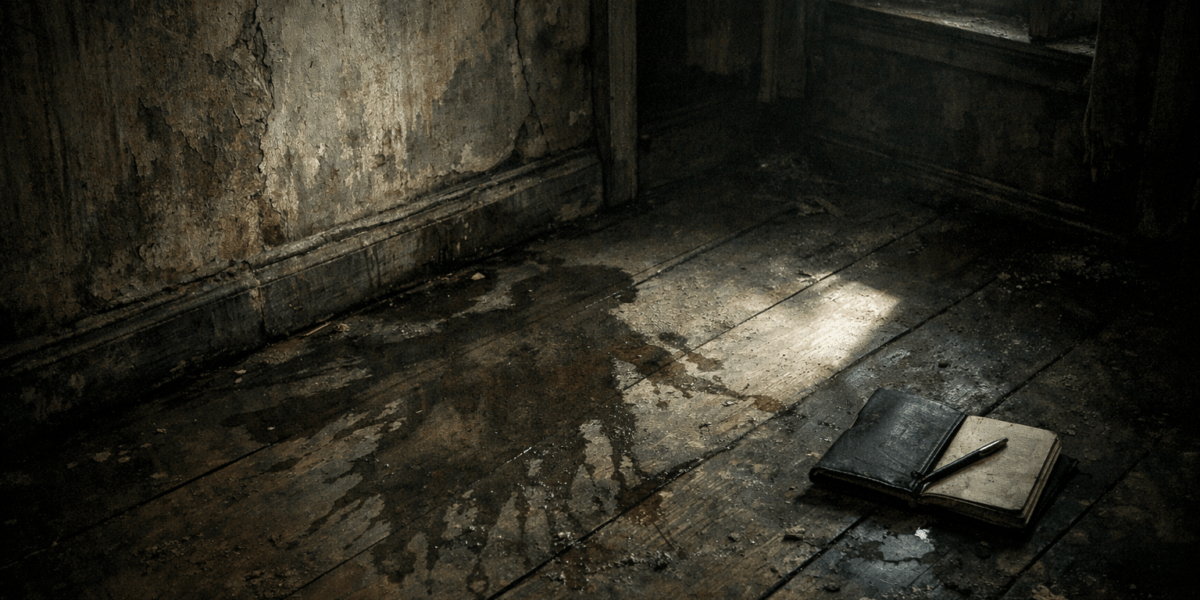
Back bedroom, northeast corner. On Friday I had squared the old wardrobe to the north wall for paint prep. I chalked a quick line along its feet so I could roll the drop cloth tight. This morning the chalk was a pale arc with empty floor where the front skids should have been. The wardrobe had yawed clockwise and slipped southwest—four and three-eighths inches from the front-right chalk, three and a half at back-left. Tape on the floor confirms it. The path is visible: a crescent of clean wood where dust was swept by movement, two bright scuffs cutting through oxidized finish. The back-left foot was damp to the touch, cool through the towel. Around that foot a faint pale ring had dried—mineral leavings, like a glass set down and lifted.
On the landing just outside, the ceiling wore a new bloom the color of weak tea. Twenty-one inches at its longest, eight wide, a soft-edged patch over the joist bay. Under it, the stair tread nosed a fine line of grit and silt as if the water had stood and then retreated. I pushed a finger through it and drew a dark streak. It smelled like leaf tannin from a barrel, not sewer, not dead mouse. The moisture meter read 22–24% along the patch at 9:14 a.m., dropping to 17% by noon with windows open. The plaster gave under my knuckles with a dead sound, not hollow, but swollen.
Low on the baseboard beneath that stain, at about knee height, the paint had lifted in a blister. When it gave, it revealed shallow cuts in the wood. I don’t think I’ve ever cleaned that run of trim to bare—dust usually hides it. Two strokes crossing, then a period, then a single line cut deep. The spacing reads like letters: E. B. The cuts are old; the grain is darkened in them, not fresh. I took a pencil rubbing on a scrap and dated it. Location: landing, east wall, between second and third risers from top.
I heard the hit last night from this direction. One clean thud at 2:19 a.m., carried between thunder and the next shudder of wind through the framing. Not the loose attic vent—I’ve taped that until I can replace the hinge. Not the cellar door; that one knocks like a spoon in a drawer. This was weight against wood. Stand in the doorway now and the angle the wardrobe traveled points back along the same line as the sound. A house can swell and slide when it’s soaked. Floors tip; everything wakes a few millimeters. But the wardrobe sat on bare wood shims I glued in last week. It took both hands and a foot to lever it into square. One bump of air doesn’t spin one hundred eighty pounds of oak.
I trust paper more than memory. So: wardrobe shift recorded; chalk arcs sketched; measurements noted; damp ring around back-left foot photographed and circled. Ceiling stain dimensions logged. Grit noted and jarred—a teaspoon into a zip bag in case I want to know if it came down the flue or from the crawl. E. B. on the baseboard, listed without interpretation.
The day warmed everything by a few degrees. The smell of wet plaster retreated to the corners. None of it argues with the noise. None of it resolves it either. Daylight makes the lines sharper, the rings whiter, the letters easier to find under lifting paint. It makes the evidence easier to see, but not easier to explain.
— Thomas Hale