
Entry #105
February 17, 2025 — 1:00 AM
I have the kitchen light low and the table cleared except for the notebook, the carpenter’s pencil, and the little pile of plaster dust I brushed off my sleeves. The house is too active tonight for sleep—small ticks in the baseboards, a quiver in the register like a held breath. I’m not going back into the run as I did—on impulse, underlit, counting corners with my thumb on the wall—so I’m writing rules I’ll follow in the morning.
Daylight first. If I can’t have good, honest light from the east windows, then I don’t go in. Exception: only with a headlamp and two separate lanterns, each with fresh batteries, plus a spare set in my pocket. No single points of failure. Test all lights for ten minutes before I start. When one flickers, I end the session.
Air and dust: the respirator with P100 filters stays on. Gloves and sleeves. Kneepads. I’ll clip the carbon monoxide alarm from the shop onto my belt—not because I expect anything exotic, just because air goes stale in old voids. A box fan at the opening if I can seat it, pulling air out. Twenty minutes in at a go, then five minutes out breathing clean.
Electric: main breaker off to whichever branch feeds the wall I’m in. No guessing. Voltage tester on every exposed conductor. If I see cloth-wrapped wire, I don’t touch it until the panel is confirmed dead and tagged.
Mapping: chalk arrows on the base of studs and on the subfloor—single arrow pointing in, double for the way back. Date and time next to first arrow: TH 2/17 09:00. Grease pencil for damp spots. I’ll carry index cards and blue tape; anything I find gets a card with location and time before I move it, then a quick photo. No moving anything until photographed, no exceptions. Sketch pad on a clipboard with a wrist strap. I’ll write distances as best I can: pace counts, tape when possible. Every turn recorded. If I can’t draw it, I don’t keep going.
Entry control: one hole opened at a time. I finish shoring and a temporary closure before I cut another. I don’t go deeper than the last mapped point. No forcing jammed panels; if it resists more than the small pry bar can handle, I back out and rethink leverage. The floor behind me stays clear—no leaning tools in the path.
Line: surveyor’s tape tied to the newel post or a stud, then to my belt. New flag every yard by estimation. If I feel the tape snag, I stop and clear it. I do not reach blind. The mirror on the telescoping rod goes first, then the inspection camera peeks where the mirror can’t.
Noise: if something shifts or taps where I can’t see it, I don’t chase it. I mark the spot, write the time, back out, and note what it sounded like. Eat before I start. No entry when I’m tired or after sundown, even with lights. Hard stop at an hour total inside, not counting breaks. If I forget what step I’m on, I end the session and put the tools away in order.
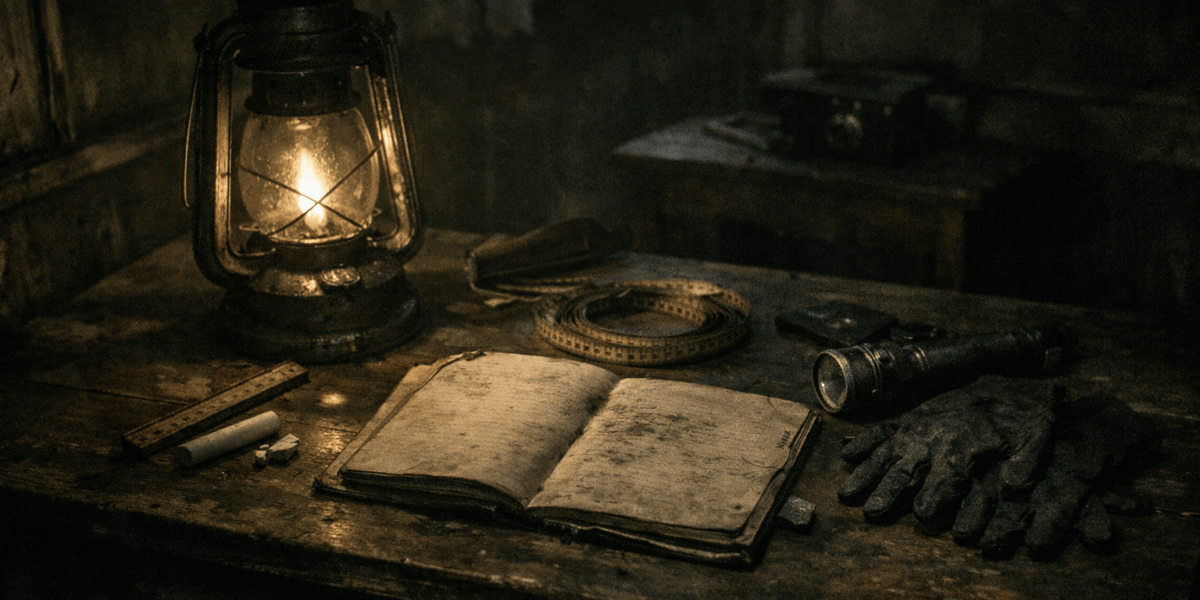
I’ll set the tools now, lined up on the runner by the hallway: pry bar, hammer, folding rule, mirror, camera, tester, chalk, tape, flashlight, lanterns, extra batteries, gloves, mask. In the morning, I’ll do them in that order, saying each one quietly as it goes into the bag. Not superstition. Just sequence.
This is me trying to make the work sane. Distance, light, air, order. The voids can stay what they are; I’ll be myself inside them. I don’t have to like how the walls bend or how a draft sometimes comes from the wrong direction. I’ll write the times I go in and the times I leave on a card by the sink. This is my house, or I’m trying to make it so. Rules are useful when the house refuses to have any.
— Thomas Hale