Entry #113
April 2, 2025 — 12:15 AM
I meant only to confirm a line. The cut-out behind the pantry—where the “courtesy layer” had hidden a deeper cavity—leads into a run between the chimney and the stair stringer. I’ve been calling it the hidden route. Plywood hatch, two screws, headlamp, respirator, chalk, tape. Ten to fifteen minutes, I told myself. Verify whether the void connects to the north bay and come back out.
The air inside was colder by a degree or two. Dust lodged in the corners like felt. The headlamp flattened everything and made mica in the plaster crumbs glint. When I crawled past the first stud, the sound changed. Less reverb. The house went into a close-mouthed register—nail-heads, wood grain, my breath wickering in the mask. Mouse pellet smell, dry and bitter. Old pitch on cut ends of pine. Someone had rasped a carpenter’s triangle into one of the studs; I traced it with a knuckle and felt the shallow stop-start of the tool.
I counted studs as I moved—eleven, then a short span where the framing squeezes toward the chimney. I chalked a faint line at the turn I thought might meet the front parlor bulkhead. On the third stud past the turn, pencil writing, almost gone: JUN 14, then a blank. Under it, a faint pair of initials. Could be S— and E—, but the second letter has been over-scratched. It’s familiar handwriting. I’ve seen it elsewhere, almost the same slant. I put the headlamp closer and the beam bounced back off a cobweb. I remember blinking hard, not to get grit under a contact I don’t wear.
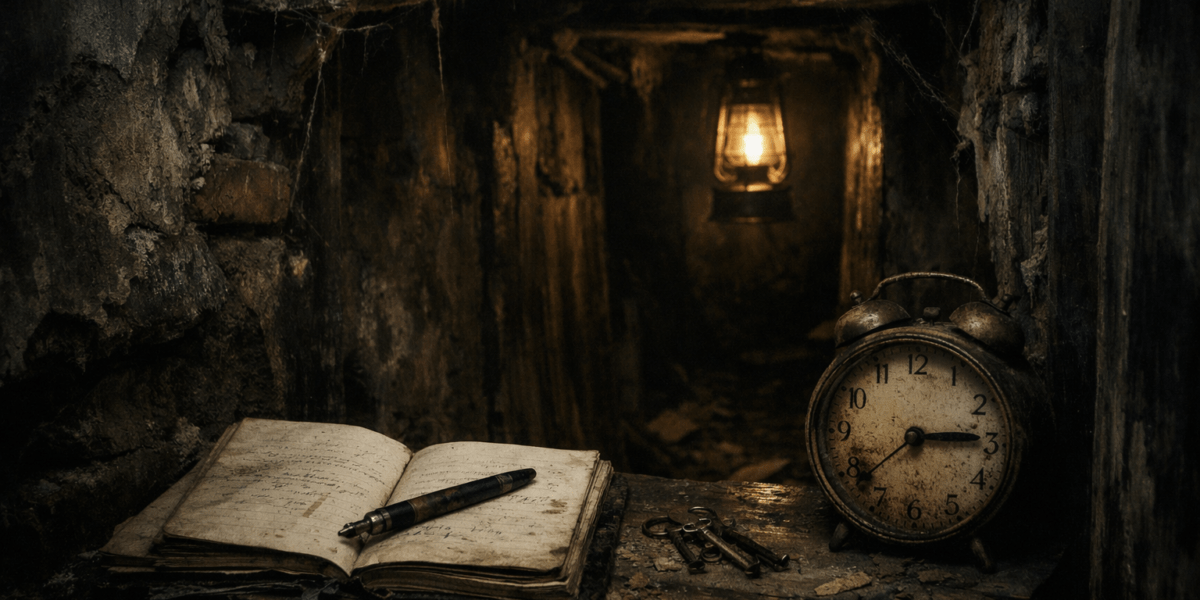
After that: the kitchen light, yellow and wide. The clock on the stove said 2:38. I stood with my hand on the plywood hatch and waited for the numbers to make sense. I checked the phone. 2:39. The timer I’d meant to set wasn’t set.
Inventory helped less than usual. The tape was locked at 17′ 6″. I don’t remember pulling it that far. There was fresh red chalk on my left sleeve cuff and a line of the same chalk across the top of my respirator cartridge, as if I’d used it to hold the string and snap it against something. The carpenter’s pencil that was sharp when I went in was down to a squat wedge. The page in my pocket notebook for tonight has a single block letter E on it, drawn heavy enough to dent through three sheets. There is a strip of blue painter’s tape stuck to the inside of the hatch with my handwriting: EAST HATCH? CHECK RETURN. I don’t remember writing it. There’s a new burr on the flathead screwdriver and a gray scuff on the headlamp strap as if it scraped a nail. My right knuckle is skinned, not badly, and there is plaster under the nail of my thumb like packed chalk.
I tried to reconstruct. If I measured 17′ 6″, I must have crawled past the chimney dogleg and into the narrowest part of the run. To get red chalk on the left cuff I would have been bracing that arm while I snapped a line with the right, probably along the sill on the outer wall. The E could be for east, or Eleanor. That thought arrived too quickly. It brought the faint taste of iron.
I can replay the first three minutes: the squeeze through, the triangle mark, the faint date, the almost-initials. After that, the sequence is a shuffle of single frames—my forearm against cold tar paper, the rasp of lath under a knee, a view into a slot that goes black, then the kitchen again. I don’t feel frightened, exactly. Just unable to stack the moments in a way that holds.
In the wide rooms, I keep track. Inside the close ones, my attention narrows until it peels away from the clock. Whatever I do in there creates evidence I only meet later.
Enclosed spaces seem to take time as payment.
— Thomas Hale