Entry #145
September 15, 2025 — 8:30 PM
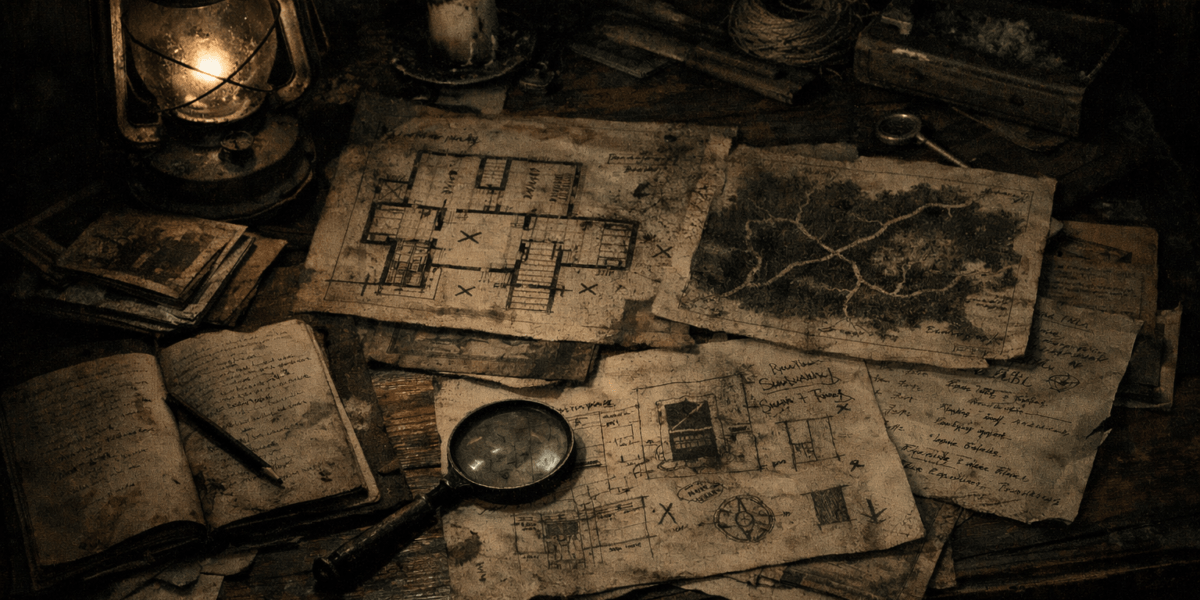
I set the lamp on the sawhorse and went back through my notes from the last three weeks—Cadence in the Studs, Sightline in Dust, Pencil at the Seams. The room was cool from the cross-draft I made leaving the back door cracked. The plaster dust in the beam of the lamp kept its own weather. The house was quiet except for the water heater ticking down.
Observation points first. The slit behind the dining room casing—two lath shaved and the plaster feathered so it reads as a hairline crack—lands neatly on the head of the table where a guest would sit, not the host. The knot bored through from the closet under the stairs, its bark turned bright where a finger once rubbed habitually around the rim, faces the escritoire in the front parlor. The bedroom transom, whose hinge pins were filed just enough to lift without tools, reveals a thumb-length aperture in the header. When I stand in each place, my eye drops naturally to the same distances. The dust rings around these cuts are smudged in the same crescent, as if shaped by a cheek or the press of a brow. Those are not accidents. People stood there, exactly there, more than once.
Routes next. The squeeze behind the chimney stack, warm in winter, cool now, where brick has been chiseled one course shallow to make room for a shoulder to pass. The underfloor track between joists two and three in the east room, where the web of old spider silk is broken in a straight line and the sap-dried edges of the joists have the polished look of worn stair treads. The attic catwalk made of mismatched planks nailed to tie beams, its nails newer than the surrounding roof, hammered flush and set. My knees found the same shallow hollows on the boards that a hundred knees would make. The smell in those runs is stable: dry wood, old soap, a metal tang near the chimney clean-out. It is not storage. Storage does not polish corners.
Repeated marks. On the rim of the crawlspace hatch: a row of notches, five then a space, five then a space, many times, cut with a small blade. On the underside of the banister, shallow grooves where fingertips habitually catch when a person drops low and moves along under it. Around one viewing slit, three light scratches in the casing, always three, repeated wherever a vantage opens, like a private sign saying “here.” I find that same triple on the back of the pantry door, where there is no obvious reason to mark it except that the keyhole there faces the yard.
Personal objects. A hairpin caught in the horsehair in the west wall. A brass button, dulled to green, pressed deep in the sill pocket under the middle parlor window. A child’s marble stuck in the dust track at the turn behind the chimney, its glass clouded but still faintly blue. In the attic, a crushed thimble stamped with E.B., and under the stair stringer, sharp with old splinters, someone scratched S.B. small and careful where the hand would rest while waiting. On the joist shelf by the front-room slit, a ring of soot the exact size of a stub of candle, and on the wood next to it a soft shine, from grease or handling, that won’t sand off quickly.
Near-language lives in the seams. Pencil lines, not quite letters, hover at decision points: a half-drawn S, a curve that could be a C or the start of ear, a line arrested mid-stroke and rubbed down with a thumb. Under the lifted transom, the ghost of a word—li—then an abrasion, and a faint cross mark beside it. Near the closet knot, a tiny arrow, then three scratches. The impressions aren’t messages so much as prompts, enough to guide if you already know what you’re doing.
When I step back from the fragments and lay them on the floor in order, the pattern holds. Watching. Moving. Returning. This concealed house was made for more than tucking things away or slipping from one room to another. The practical work is bound up with something else, and the house has kept both—use and residue—with equal stubbornness. The intention is human and the remainder is not entirely. I don’t need a name for it tonight.
The hidden house was not only a place to go, but a place from which to know.
— Thomas Hale