Entry #162
November 30, 2025 — 7:00 PM
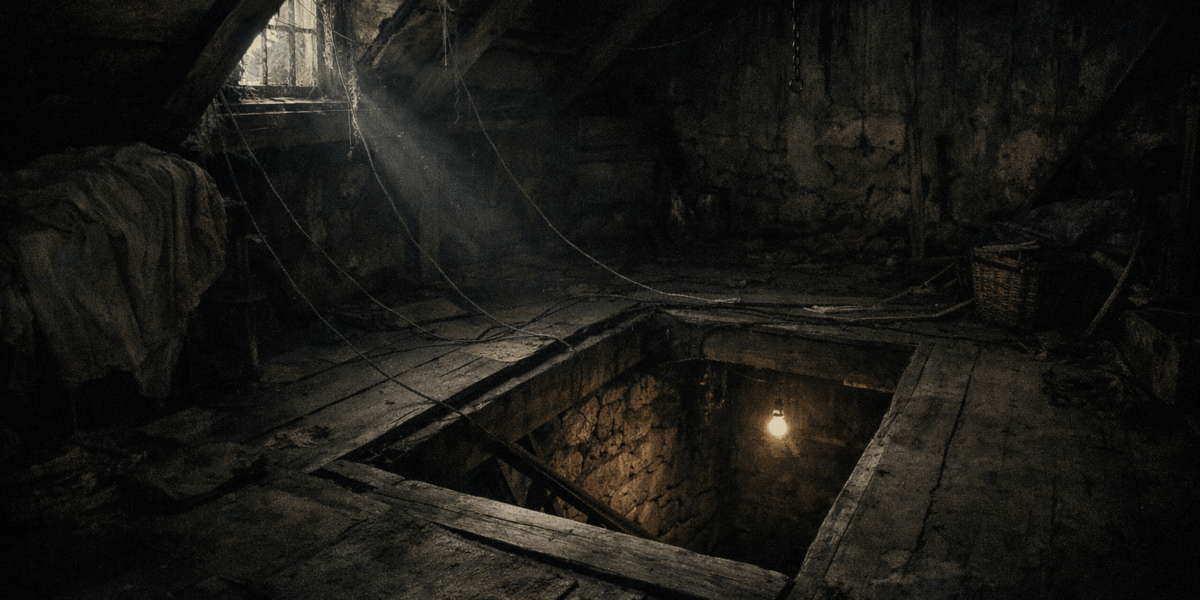
The afternoon held steady light and a dry cold. I took the short ladder to the upstairs hall and pulled the attic hatch down. The string on the hatch door always leaves grit on my fingers. The air up there is different—cooler, with a faint sweet-fat note under the dust, like old candles kept too long with linens. I brought the headlamp, a tape, and the chalk line I’ve been using to keep my points true from floor to floor.
I marked, weeks ago, a centerline from the cellar pier up through the stair landing. In the hall, it crosses directly under the hatch. That still feels like coincidence until I put the level to the jamb and find the same stubborn out-of-square drift I found on the beam below: a little under half an inch over two feet, leaning west. You can argue with sounds and shadows. Measurements talk back less.
Insulation up top is the gray shredded kind. I pushed it aside with gloved hands and the paper crinkled like old tickets. The roof boards are rough, saw marks still visible; the nails are rose-headed, driven hot. Between two rafters, right where my chalk mark came up, there’s a seam in the knee wall that doesn’t close—someone left a slender, purposeful gap, as straight as a rule. Not a careless split. Not settling. The light catches it and doesn’t bounce; it goes in and is swallowed a few inches down, the way the beam of my lamp does in the cellar niches.
I tapped the board next to the gap with the butt of my screwdriver and listened. The sound stood up in the narrow space and went somewhere thin and long. Not hollow, exactly—biased. I tied a nut to the end of the chalk line and fed it carefully into the gap. It slid on wood, clicked once, then more faintly below. The line took more of itself than the depth of the knee wall, and when I let it hang, I could feel it draw a plumb that wasn’t free. Something below was confining it.
On the underside of the hatch, where the paint has flaked, someone scratched two letters shallow, then painted over them long ago. The knife scored through the earlier coat and left raw wood that took the later paint badly. S.B. The B is squared at the bottom. There’s a fine bead of brown wax—if it is wax—pressed into a knot near the same edge, packed hard into the swirl as though with a thumb. I scraped a flake loose. It didn’t crumble. It softened between finger and nail like tallow and held a smell that matched the cellar—sweet turned heavy.
I don’t want to make too much of echoes. Houses repeat by accident all the time: a carpenter works one way in one room and keeps at it upstairs. Still, the gap sits on my line, and the angle of the jamb leans as the basement beam leans, and the same small residues cling where they don’t have to. When I breathed near the gap, the draft pulled in steadily, not rafter to rafter but along something vertical. The house prefers a path even when I don’t see it.
Above and below are more than stacked floors. They answer each other. No level of this place is innocent of the others. I’ll keep to my marks and keep from guessing too far ahead. Recurrence is more persuasive than novelty in old houses.
— Thomas Hale