Entry #232
November 3, 2025 — 2:30 AM
This afternoon’s light had that flat November quality that shows every flaw. I took off the oak paneling along the stair hall, the section that had bowed away from the plaster years ago. The pry bar rang dull against cut nails. Dust lifted in slow bands, bitter lime and mouse. Behind the paneling, the plaster scratch coat held a field of lines.
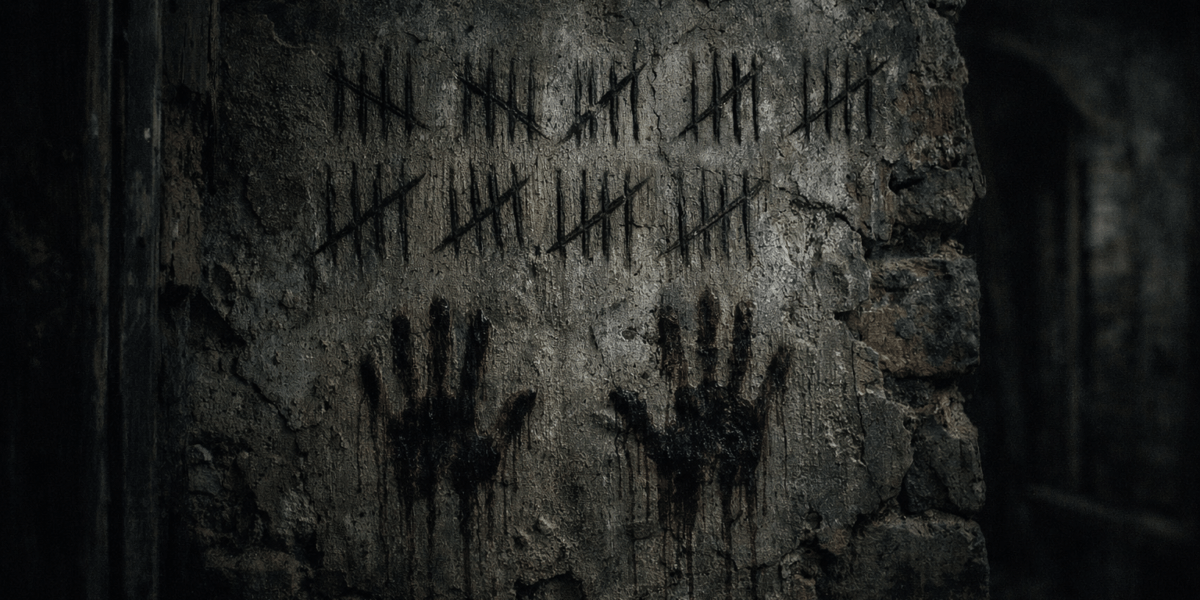
Not the hatch-marks I’ve been seeing on door heads and casings. These were ruled. Someone had snapped chalk lines plumb and level, then incised along them with a sharp knife. The cuts were clean and consistent; the blade must have been stropped often. At certain intersections the lines thickened into shapes I’ve been calling “flags,” but here they had proportions, not the lazy forks I find near the newer thresholds. Nine knife-widths one way, three the other, a notch taken out at a fixed interval. The later tallies try for that mouth and never get it right.
Under the first tread, on the back of the stringer, there was a board used as a template. Plane tracks still visible, chamfer broken on one corner. Someone had laid out a quartered circle on it with a compass, scribed concentric rings, then cut little teeth along the east quadrant only. Beside it, in pencil now turned silver, a cramped hand: “S & E Blackwood — Jun 14 1891.” The graphite had sunk into the grain. Over it, decades later by the look of the softer lead and thicker loops, another hand traced the same letters freehand, bigger, looser, trying to honor the first line and missing its economy.
I kept going. On the reverse of two baseboards pulled from the dining room corner, more of the old marks, formalized: paired chevrons whose spacing matched the knife layout in the hall, and a small dot at the chevron’s root. On the face side of those same boards, from a different era, there were faint scratches copying the chevrons but without the dot, rotated forty-five degrees. Whoever came later had the shapes but not the rule that sat under them.
What I’ve been calling a system is older than the last owners, older than the bad paint and the improvised fixes. The house carries an earlier draft of its own notation beneath the skin. The later hands—whoever they were—weren’t inventing; they were inheriting. They simplified where the formal marks distinguished. They repeated flourishes and dropped the constraints. I can tell because the old work shows its scaffolding: red chalk ghosts, compass pricks, knife lines under the strokes. The newer scratches float without those bones.
The Blackwood name is turning up where the work is most disciplined. Not in the show places, but on the backs of things, inside joints, where no one needed to see unless they were building a language into the walls. The date on the template is the deed date. It reads less like an owner’s pride and more like the first entry in a ledger. I don’t know yet whether they were the first to document the house or the first to be documented by it, but either way, everything after feels like commentary.
This is not a code I can crack in an afternoon. It has a grammar, and it is historical. The house holds to that history and rewards it. Today made the later marks look like what they are: copies.
Imitation is one of the most reliable signs of authority.
— Thomas Hale