
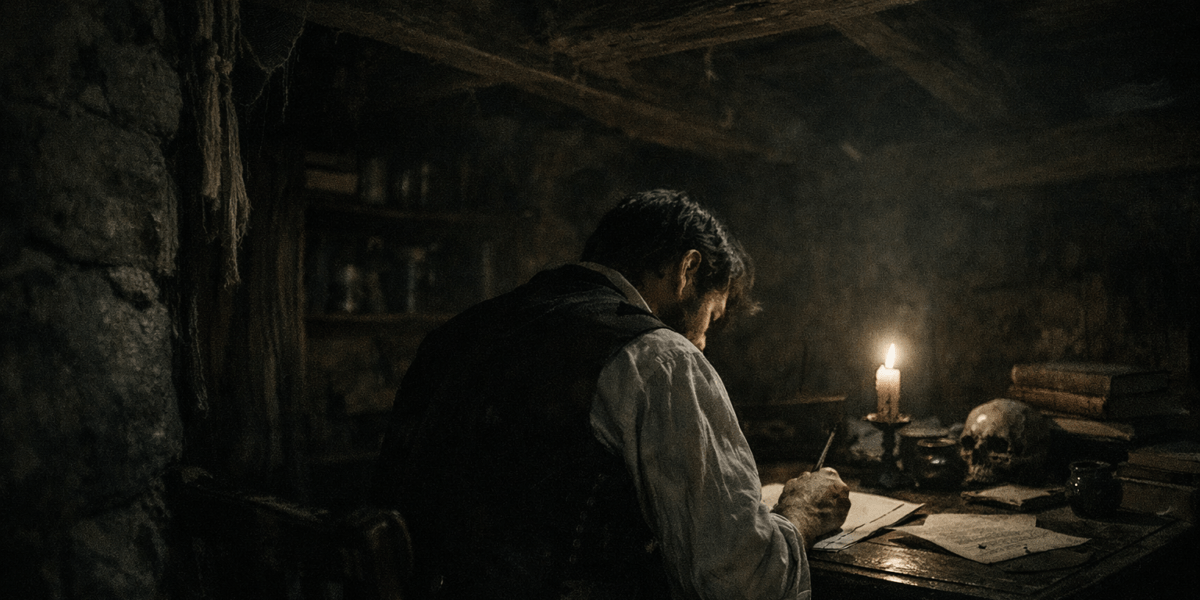
Entry #240
November 27, 2025 — 1:00 AM
The work light throws a hot circle on the dining room floor. Cold everywhere else. The dust I didn’t sweep up makes a low ridge along the baseboard like a silt line after a minor flood. The smell tonight is cut pine, metal filings, and the graphite on my thumb from the dull pencil.
I pulled the casing off the east doorway this afternoon to shim it plumb. On the hidden face, in pencil so thin it looked like the grain itself, a hand had written: Samuel Blackwood — and lower, in a second, fainter line, Eleanor. Then 1891, the 1s like fence posts. I know the date from the deed — June 14. Their signatures match. The same pressure in the E, the crossed A like a carpenter’s square. The rest of the board was covered in hash marks I first took for fast math. On the next piece, the name was shortened: S. & E. Black— then only a long drag, as if the pencil broke or the hand didn’t return.
I’ve been following marks and stations for days, measuring where they measured, finding notes where they hid notes: on the underside of a stair tread, chalk rubbed and blown away in the same grey bloom as my breath; in the cavity between studs, a twist of paper with a grid of doors and windows, doors and windows, the words repeated until they turned into single letters and then into the pressure of the point alone. The house keeps its people in pieces they made while working: initials, ticks, templates, not whole sentences. Reduce and repeat, like the way a loose board will thump the same note every step until you think it’s your heel.
Tonight I walked the rooms after the light went: the same corners caught the same air, the same nails showed through paint like old constellations. I caught myself re-measuring the wall between the parlor windows with the same numbers I wrote yesterday and the day before. I am not losing track, I told myself. But I put the tape down and couldn’t remember if I had eaten or if that was last night between studs and stations. The house is not doing anything to me — this is not that kind of thinking — but it has its ways of preserving. They are small and blunt and they wear you down into easy shapes.
I started this journal because inspectors like dates and clean lists. The site was to keep me honest and keep others informed, and maybe, once the roof was tight and the joists sistered, to make a tidy before/after record. I see now that the act of writing is more like framing than like photographing. A record isn’t passive. The pages hold a line the way a level holds a bubble. The ordering of what came first and what came next is itself a kind of joinery.
I don’t mean that words ward anything off. There is no charm in this. I mean that when I write out the work and the findings, I don’t just remember them; I decide their sequence and weight, and that choice resists the way the house prefers to keep things: pared down and iterated until you are only a mark under a casing. The journal fixes direction. It tells me which wall came before the other, and that there was a meal between them, and that November is not July even if the light through the south window falls at the same angle.
Samuel and Eleanor signed a legal sheet once, and they left their names behind paint and under treads. I don’t know if they were the first to write the house, or if the house wrote them by sanding their days to initials. Either way, their fragments tell me the method is older than me. If they began a keeping and were reduced to shorthand, then what I make has to stay longer and run straighter than chalk on a stair.
So: the entries will be numbered and dated and kept with the plans. I’ll add scans of the found writing to the site with context, not just images. Where I find a repetition, I’ll pin it to a sequence. Where I am tempted to let a day go uncounted, I’ll set it in place. If the house prefers to break things into pieces, then this becomes work against the grain.
If the house preferred fragments, then continuity would have to be made by hand.
— Thomas Hale