
Entry #251
December 29, 2025 — 12:15 AM
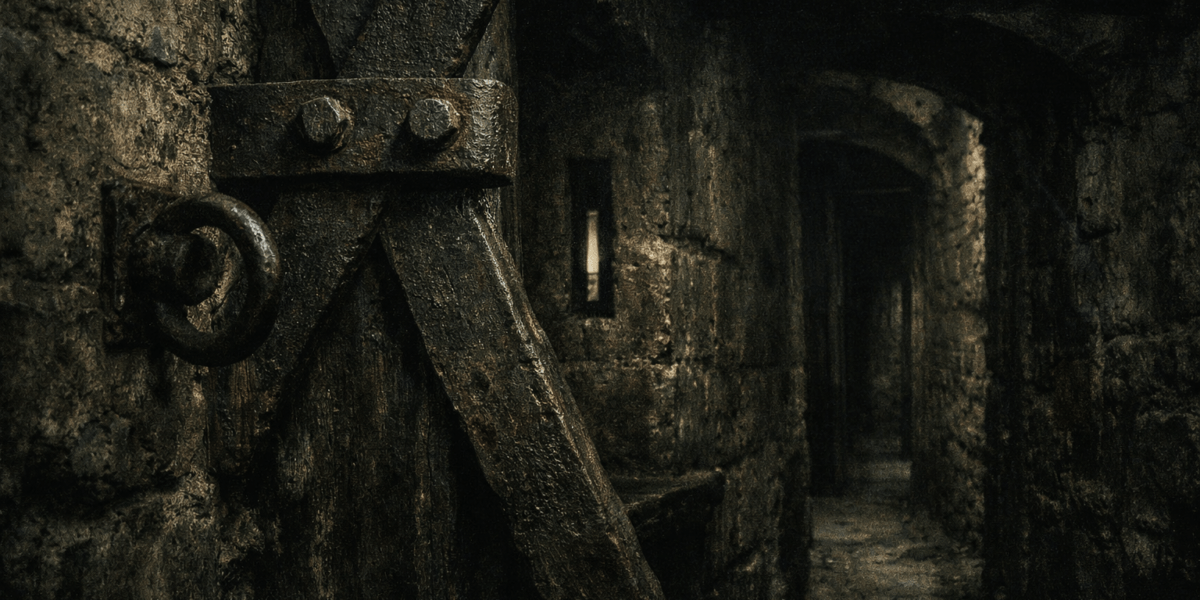
Midday work reveals more than night. I took the casings off two interior doors to run new wire and found the strikes milled for key-turns on the hall side, not within the rooms. The old mortises are clean and original, the screw slots uncrossed. Whoever hung these doors set them to be decisive from the corridor, not by the person standing inside. The bevel on the stop moulding is undercut toward the room—subtle, but it denies any shim worked from that side. The function is not privacy. It is position.
In the south hall there are pockets cut into the jambs waist-high, facing each other across the opening. They look like decorative grooves until you line them up. A bar would seat there, end to end. The paint layers run over them in a continuous history. No fresh chisels. First generation.
I pulled a floor register in the front parlor. There is no duct, only a black shaft boxed between studs, tight, with baffles set at angles like a letter slot turned inward. The baffles kill drafts from the room but shape sound out. When Mae spoke in the kitchen, I could hear her vowels flatten through that shaft, not loud, but clear in timbre. Following the shaft upstairs, a small closet between bedrooms has an upper panel peppered with pinholes in a regular grid. Dust has gathered in crescent arcs around them at eye height. Someone stood here, face close, long enough to leave vernix marks in gray.
Under the main stair I found a removable baluster with a brass catch. The piece is heavier than its neighbors and bored through, centerline true. Set back in its pocket, it makes a slit that faces the front hall landing. Not a mistake—there’s a rebate cut into the stringer to accept its sightline. You would have to know it to look for it. It is worked with square nails and the same shellac as the original treads.
In the cellar, along the sill beneath the dining room, there are eyebolts set low into the posts, but they point inward, not out; they are not for lifting. The spacing is consistent, a span that matches a human shoulder width if you stand between them. The wood is burnished in a way that suggests touch over time, not impact. The bolts themselves are hand-forged and set before the first whitewash. They predate every retrofit I’ve found.
On the back of a removed door plate, the carpenter’s pencil marks are still legible: little arrows, a fraction, an initial. S.B. at the hinge side, E.B. at the stop. The graphite is old, the strokes deliberate. The same initials, again, in the closet with the pinholes, written small along the brace. The deed from 1891 carries Samuel and Eleanor Blackwood in ink. Here the house carries them in dust and lead. I don’t know if they were cataloging what they made, or if the house had already begun to catalog them.
The thresholds tell their own part. In three rooms there is a second strip of hardwood set just inside the line, not anywhere else in the flooring—two inches, end-grain showing, as if a subtle ledge underfoot. Stand there and you feel contained by it, without seeing it. The wear is deepest right on that strip. Held feet, waiting.
These are not eccentricities. They align: locks that answer to the hall, bars that live in the jambs, vents that give hearing without air, sightlines hidden in joinery, a measured place to keep a body still. The wrong at the base involved people. Control and witness were drawn with the first pencil, cut with the first chisel. The oldest system was deliberate. Architecture becomes accusation when it reveals who was meant to stand still and who was meant to watch.
— Thomas Hale