
Entry #18
October 14, 2023 — 7:00 PM
The work light throws a cone down the cellar stairs that makes everything else look deeper. I brought tape, a carpenter’s pencil, and a sheet of tissue I tore from the packing box in the hall. I told myself I was testing air movement, not chasing sounds.
The same cool smell waited when I cracked the door. Not rot exactly—more like wet limestone after rain, with a thread of iron. The draft touched my shins as I stood on the top tread. I closed the upstairs window at the end of the hall and came back; the draft shifted but did not stop. Stack effect, I said out loud, because it’s true. Warm air rising, cold air drawn from low points. Old houses breathe whether I like the word or not.
I pressed the tissue along the jamb. It fluttered, first toward the hinge, then toward the latch when I put weight on the third step. That same faint scrape answered from below when the paper moved—light, like a nail easing along stone. I kept still and timed it against my breath to rule myself out. It came on the exhale, twice, then stopped.
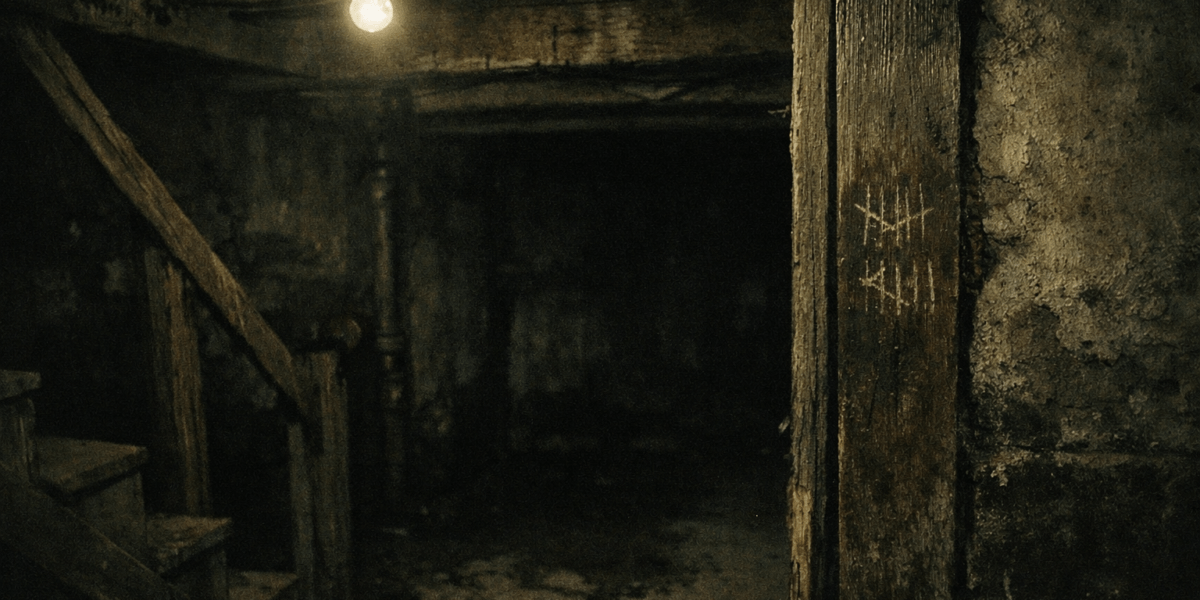
The treads here are painted brown and ground to grain at the nosings. I knelt at the riser where I’d rubbed wax before, over that shallow nick I couldn’t read. The wax is gone—swept, I suppose, when I cleared sawdust two days ago—but the mark shows clearer now, as if the pigment traced the groove and left a stain. A straight vertical and a short middle arm: it could be an E. Below it, five inches to the right, a looped line that makes a clean belly before turning back—half a B if I’m generous. I don’t like forcing shapes, so I took the pencil and shaded lightly over both. The lines received the graphite more readily than the surrounding paint. Fresh wood is pale. Old cuts keep their edges.
On the next riser down I found a second pair, fainter, in reverse—like someone traced from the other side of the board. I ran my fingertip along the seam where riser meets tread. Cold air slid out and down my finger. When I lifted my hand, grit ticked onto the toe of my boot. The scrape came again, a patient inch. Mouse, pipe, settling mortar—any of those would be ordinary. I said all three in order and listened to the sound the words made in the empty stairwell. They helped, a little.
The wall to the right is fieldstone with a skim of mortar. My earlier line outside, under open sky, has its echo here: a hairline in the skim coat, straight for two feet and then lost in rougher work. I pressed blue tape along it the way I did upstairs beside the bed, to see if tomorrow shifts it. When I smoothed the tape, the tissue by the latch fluttered again though I hadn’t moved my feet. I put the paper down and watched it settle. It didn’t.
I marked the spots with small ticks of pencil—discreet, not big crosses—and noted the measurements in my pocket book. The cellar isn’t getting stranger; I’m only getting more systematic, and that makes strangeness show its seams. If I keep cataloging drafts, hairlines, and scratches, their pattern will collapse into work: pull the risers, rebed loose stone, backer rod where the gaps are widest, paint that isn’t chalking to nothing. It’s easier to be here when I’m thinking about material instead of meaning. Renovation makes this place tolerable because it keeps my hands busy.
— Thomas Hale