Entry #210
September 1, 2025 — 10:15 PM
I cleared the kitchen table and spread what I’ve taken from the walls these past days: the rubbed niche stone from the stair turn, a sketch of the parlor sightlines, the dimensions of the listening shelf. The room held its low refrigerator hum and the metronome of the stove clock. I kept the light pointed down and worked by the circle it made.
In the pantry I pulled the last strip of beadboard from the back wall. Behind it was not framing, but a grid of small pigeonholes, twelve across and six down, hardly deeper than a hand. Each had a narrow lip for a paper tag. Some tags remained, curled like dried leaves. The dust there was a softer kind, flour-fine, with the smell of old glue and pepper. Fingertips had left permanent polish on the front edges. This wasn’t improvisation. It was furniture made for a task.
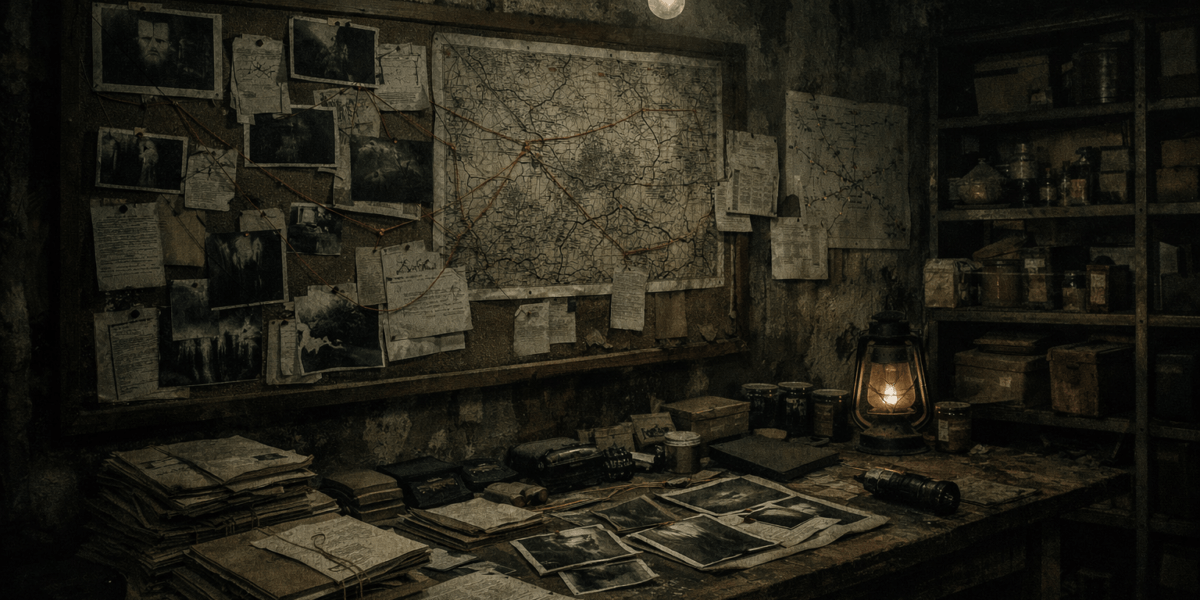
Inside the holes were paper packets tied with string. When I loosened the first, thin slips fell out—each ruled with a center line, each marked in pencil with a time, then a short, precise note. 3:47—foot on the third stair. Sunday—coalman late, argument at gate. The hand stayed mostly the same, but a few cards carried a smaller, cramped variation, the kind you use when you write in bad light. Chronology fragments in piles. Not stories. Measurements.
I took one slip to the parlor and stood where the sightline catches the kitchen door without being seen. The sight spoke exactly to the note. From the listening shelf, sound climbed clean through the joists to this point; the niche at the stair would keep a watcher still and out of the wash of lamplight. The repeated marks I’d been finding—small paired nicks along the baseboard at shoulder-height intervals, not decoration—turn out to align with eye positions for different doors. A house dotted with stations: you listen here, you wait here, you watch there. Then you file.
On the side of one pigeonhole, under the curled tag, there was a second, hidden label, linen-faced, with a line of faded ink. Not a code. A name: Blackwood. The B and W darker, as if the nib caught there. It didn’t feel like discovery so much as being let into a system at the level where people mark what belongs to them. I searched it quickly on the county site. Nothing useful. The telephone index gave me a scattering of lawn services and a bakery three towns over. No one that fits this house, or this century.
The more I laid the slips with the sketches, the more the pattern showed itself. The house didn’t merely catch what passed through it. It created posts and rhythms. It gave posture to waiting. It conserved noise and angles and scheduled them as evidence. Hidden observation and preserved paper belong together here. The horror is not in a single event, but in the maintenance of it. Habit over hunger.
I will map the rest of the grid tomorrow. I am not tempted to pull it out. It is better to learn the procedure as it was kept. Tools have ways of teaching you what they were made to do. This one keeps its voice low and its hands clean.
Secrecy becomes a profession when a house is built to support it.
— Thomas Hale