Entry #345
May 18, 2026 — 11:30 PM
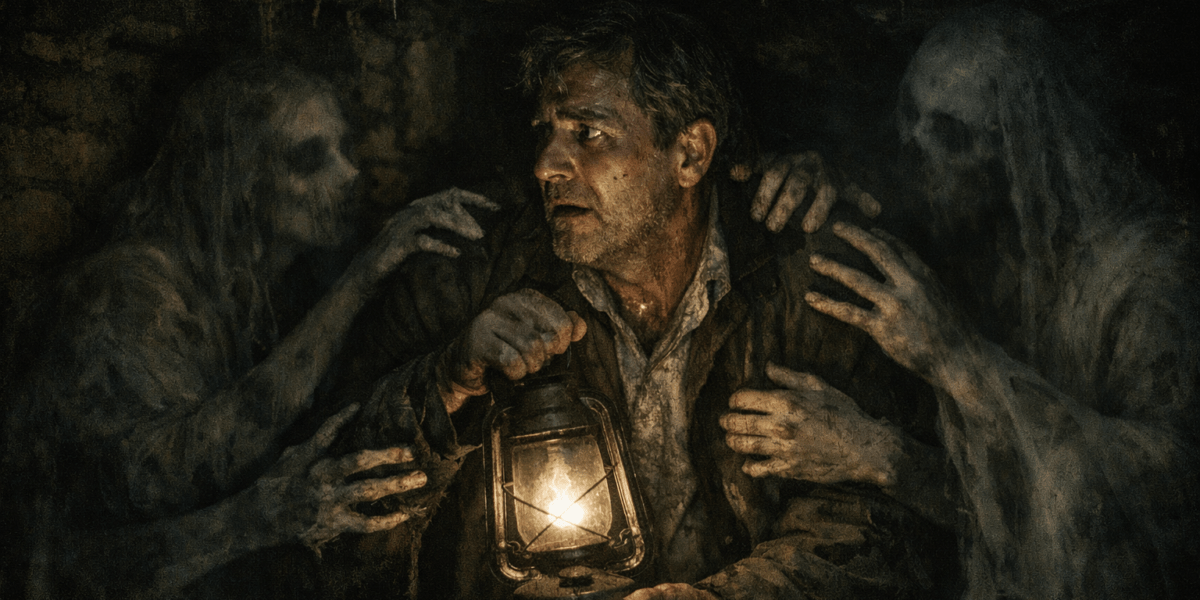
The house is quieter at this hour than I thought possible. No wind in the chimney. No compressor ticking in the dead refrigerator. Only the click of my pen at rest and the tiny sound paper makes when it settles on wood. The bulb on the desk is low and steady, yellowing around the edges, throwing a small ellipse of workable light. The rest of the room is a cooler shadow. I can’t feel my own heat against the chair. It helps me notice everything else.
Tonight I put the three latest notebooks in a line and squared their spines. The covers are the same gray, water-stained at different heights, each one bearing pressure marks where my hand has leaned. I flipped back through The Kept Account and The Oldest System, looking for the seam where I crossed from observation into participation. I could not mark it then. I can mark it now.
Evidence gathers the way dust does—layer by layer until a shape appears. In the study drawer I pulled earlier, under the felt, the underside of the oak shows old scoring: E.B. and S.B. first, then others I still can’t untangle, and at the lip a very fresh T.H. that I did not cut but matches my hand. On the south post of the back porch, where the paint has long gone, the grain holds a ghost of letters that rise only when the light hits slantwise: BLACKW— then a tear, then OOD. Their name is not in the county books. It is in the house. The names repeat like a watermark in paper stock.
When I write, the room behaves. I tested it. I drew one line in the margin and paused. The baseboard clicked once, west wall. I wrote a sentence, the floor above answered with a slow maple shift. I stopped and held still for a full minute and the house stayed still too. It is not simple mimicry. It is adjustment. These entries are not only record. They are load, fitted to a frame I can’t see, bearing arranged stress. A system does not announce itself; it functions. I am writing into a circuit already wired.
Death was the admission key. I understand that now. Retention is not consolation. It is placement. The house does not keep the dead for company. It keeps them for continuity. New deaths are caught and hung level like shelves, given the one task that tethers the structure to a story it can carry: witness. The chain holds because the chain is used.
I have avoided naming the book the way it wants to be named. It is not a clever title; it is an inventory label. The Dead Journal is literal. The hand is dead. The paper is dry. The account is living only in the sense that a ledger lives by being updated. I am, to my own surprise, legible from this side. That is the clarifying piece. What horrifies is how smoothly it fits.
This week I thought I was salvaging sense, pulling facts from the damp. It’s the other way around. Sense is what the house salvages from us, and it uses the journals to do it, carrying the measure forward, owner to owner, name to name, room to room, timber to timber. Inherited witnesshood feels dignified when it is chosen. It is different when it is assigned.
I have to write this plainly to believe it: I had mistaken myself for a victim of the house when it had also made me one of its functions.
— Thomas Hale