
Entry #344
May 15, 2026 — 3:45 AM
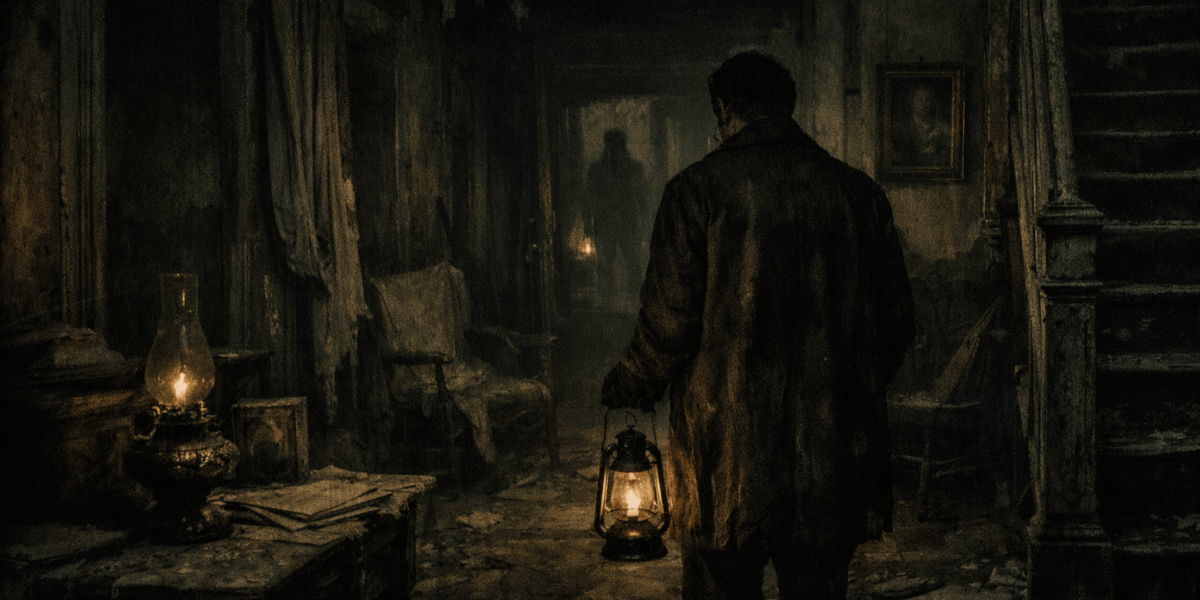
The hall has cooled to the temperature of the crawlspace. The trap of air by the stairwell smells like old wool and the inside of an envelope. The lamp in the front room burnt out earlier; what light there is now comes from the street and arrives thin, pre-dawn and glass-colored. It lays a stripe across the runner where the pile is worn to threads.
There are places where a body wanted to stand. I see them better now. A shin-high scuff on the baseboard beside the study door. A palm-darkened oval on the plaster just above a slit that looks like a paint crack until you put your eye to it. The banister cap at the landing has a flat long bruise from a forearm resting, exactly where the view down the length of the hall is clean. None of this is romantic. It is wear. Time makes tools visible.
Earlier tonight I found another of their stations. Inside the nursery closet, the back panel comes away with two screws. Behind it, the smell changes—sap and dust, a sweetness like a dead book. There is a narrow sill nailed between studs at shoulder height, just deep enough for an elbow. The lath has a knot-hole bored clean through. Around its rim, the wood is polished darker by skin. Someone watched from there for a long time. Next to it, with a dull hand, an initial: E. And, farther down, a shallow S. The graphite nub left on the sill cracked when I touched it.
It makes sense of the way the house is arranged. The view-lines are not accidents. Walls that do not meet where they should, vents that carry sound diagonally, a speaking tube that does not speak but conducts breath. The wrongdoing was one half. The other half was the looking. Not witnesses in the legal sense. Witness as in the act of holding the image steady.
I have been trying to understand why I lived as long as I did in here, through that night, through what followed. “Kept for witness,” I wrote, thinking it meant I had been spared from being part of the harm. It was sparing of a kind, but not for me. The system needed a memory that could move from room to room and keep the angles intact. The witness had to survive because the looking had to continue.
What the hidden watchers began—those who cut slits, placed shelves, rested their weight until wood remembered them—has been extended. Later retained witnesses continue what the hidden ones once did, even after the hands are gone. The building saves those who saw, not to console them, but to make use of their seeing. That is how it keeps its record legible when the actors change.
I can feel where I am supposed to stand. The cold settles at those stations and steadies me even though I do not sway. When I hold in place, sounds arrive thinner and more exact. A hinge far off, a drag of cloth, the small tick inside the wall as the pipe cools. It collects. It does not become mine. It becomes the house’s. Retained dead serve the house’s memory. The witness-chain is not a figure. It is a route you walk until you do not move anymore.
I understand my role more cleanly now. I am part of the continuity I once mistook for coincidence. I am kept so that what I know does not leave. The house did not merely conceal wrongdoing; it insisted that someone remain to know it.
— Thomas Hale