
Entry #255
January 3, 2026 — 11:30 PM
I started the morning with new blades and a broom. The winter light off the snow came in flat and cold, good for seeing edges. The house kept its chill even with the heaters running; my breath went pale when I pried up the first run of beadboard on the stair landing. Dust smelled sweet from old pine and a little rank from mouse and damp burlap. Nails gave with a tired scrape.
Behind the landing riser I found a narrow shelf, no wider than a forearm, darkened where skin would touch. The lip was polished down to a quiet shine that the rest of the wood didn’t have. At elbow height, a small brass tack was bent over as if it had held a loop of string or a stub. There was a knothole in the next stud bay, bored clean; when I pressed my eye to it I could see the north bedroom, a slice of wall where the bed frame had once been, a corner of window. At the back of the shelf, a scatter of wax grains had caked in a seam. Someone sat here. Not once. Enough to make the grain remember the press of an arm and the turn of a cheek.
In the pantry I opened the shallow cupboard that had never made sense for food. The back came off in two pulls and revealed a fitted board with a lip like a small desk. A groove ran in it where a hand had dragged a pencil the same way, over years. The surface bore the pale rectangles of paper that sat in one place too often—dust kept, dust kept away—and the faint impressed ghosts of lines and columns you could catch by raking the light: numbers, perhaps, or dates. Three thin sheets of spent carbon were fused into the seam, blue gone to black. Above the board, tiny pinholes in a tight row. It was a place you wrote, not once, but like a duty.
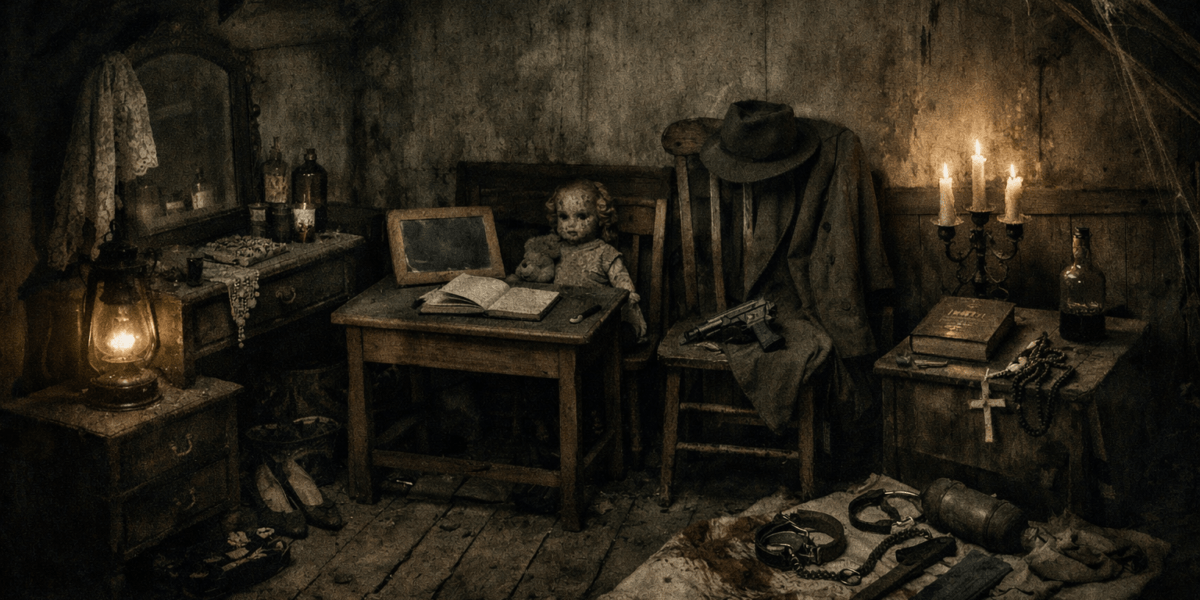
The north bedroom gave up its habits slowly. The jamb showed old screw holes where a hasp had been, outer face scarred from chisel work and then painted over. On the floor, an oval your foot could find without thinking, a patch worn smoother than the boards around it, not central but along the window wall. The baseboard there was scraped down to raw in one hand’s width, low, where something rubbed or worried it. In the sash groove I tweezed a small curl of hair, too old to tell much except it had been caught there and stayed. A white ring on the floor, the right size for a tin cup. It was not arranged for comfort.
Behind the parlor mantel—plaster cold, grit under my nails—I found the varnished back of a letter flap, brittle and still sticking to a splinter of wood. The paper was mostly gone, eaten out along the grain, but the tail of a sentence remained in brown ink: “for the one who comes af—”. On the inside of the pantry door, higher than my eye, there were two columns of short strokes in two hands: one light and neat, one heavier, crossing and checking. They didn’t run on forever. They paused and started again adjacent, newer over older.
On the underside of that little desk board, someone had pricked letters with a pin, each dot breaking the shellac: S. B. The back wall of the stair void held a graphite loop, half-erased, E. B., with a line through it as if someone had tried to take it back. The deed I pulled a week ago is dated June 14, 1891. The names on it are Samuel and Eleanor Blackwood. I don’t know whether those initials were theirs. They sit exactly where you would sit to watch, or write. If they were the first to write this house, or the first to be written by it, I can’t tell. The wood is older than my questions.
What I keep finding isn’t spectacle. It reads like work. A seat to look from. A board to total what was looked at. A room that kept a person in one place long enough to wear its edges. A scrap that expects a next pair of hands. There were parts, not only people, and people fit themselves to parts. None of that cleans any of it, but it changes the shape of blame when a bad thing is a routine. I am trying to see the faces without making them for my own comfort.
The house appeared to have required not only suffering, but arrangement.
— Thomas Hale