Entry #132
July 9, 2025 — 1:00 AM
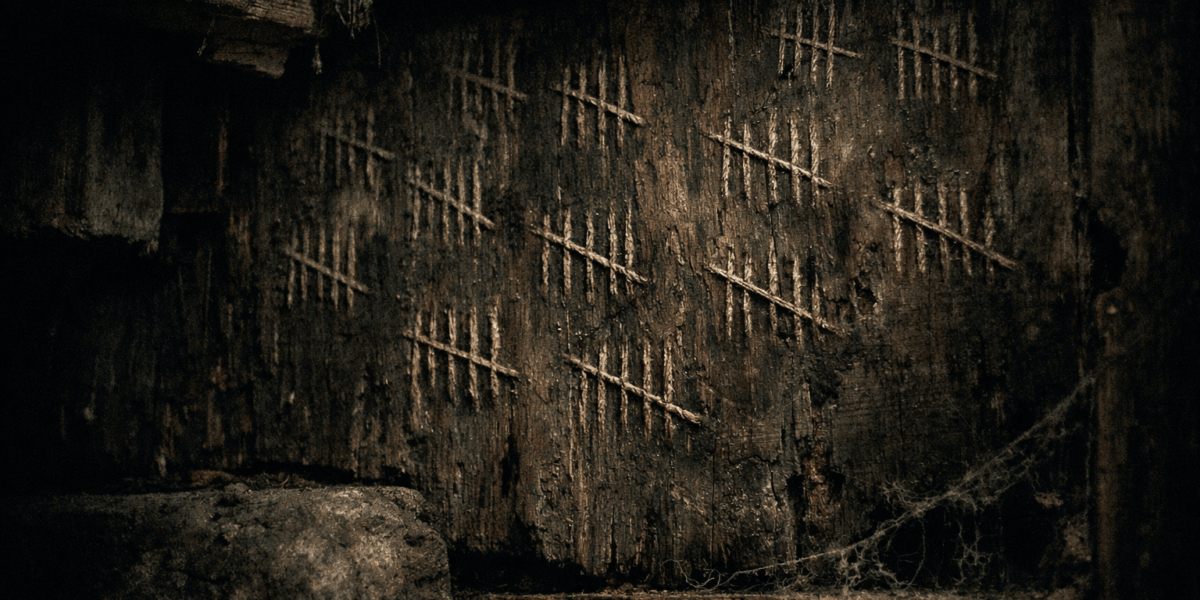
This afternoon I pulled the west hall baseboard to continue the hollow draft from yesterday. The sun pushed through the high window and made the dust look heavier than it was. The wood gave with a dry sigh and the nails came out crooked and red. Behind it, the plaster edge had a run of scratches I first read as incidental—installer chatter, a slipped blade. Then my eyes grouped them: four thin verticals, then a diagonal cut crossing them. Five. The cluster sat an inch above the floor, repeated at regular intervals along the wall, every fourteen or fifteen inches, but not on every stud. Some were doubled, as if someone came back and added a second cross.
On the back of the baseboard itself there were Roman numerals knifed into the soft pine: VI near the corner, then VIII, then a faint X with a small additional nick to the right of it. Carpenter’s marks aren’t unusual; I’ve found them on old frames before. What stopped me was how these weren’t just joint pairs. The numerals continued past the scarf, into boards that never would have met in the original fit. And under two coats of house paint, the cuts are clean. Someone updated the count later, on finished surfaces.
I went room to room with a flashlight and a pencil, slow-mapping as I went. Under the radiators in the parlor, where heat baked dust into the floorboard seams, I found tally clusters burned a little darker, as if a hot point bit them in. In the kitchen, behind the beadboard under the sink, the same five-counts ran horizontally until they turned up at the corner and became a descending set of III, II, I along the next wall. In the cellar, on the first beam east of the coal bin, there’s a neat XII and, two joists over, IIII with a barred V beside it—a correction or an emphasis. The attic rafters carry matching marks, but the spacing is different, more like staging: I, II, III, pause, then another I by itself, set off with a dot.
In the stair stringer cavity—the place that rang hollow on Monday—I scraped away the paper-thin skim coat and uncovered a narrow field of repeated pairs: // // // grouped into sixes and eights, then a square-cut notch alone. They line up with where the void narrows. In the dining room, behind the wainscot where the plaster dust smells like old soap, a grid of penciled V shapes sits beside shallow knife nicks. One of the Vs is capped with a short horizontal like a T. Next to it, very faint, two initials: E B. The pencil line has bled into the grain with age; the knife marks are bright and new by comparison.
The spacing matters. When I overlay today’s notes on the hollow plan from Entry 131, the counts step along the same path the void takes. Where the chase splits behind the bathroom wall, the numerals split too. Where the lath was doubled for a patch long after the house was first set, someone came back and continued the series on the added wood, matching the older cadence. It isn’t random, and it isn’t only original assembly. It reads like classification—someone keeping track of parts the eye wasn’t supposed to see.
I caught myself moving differently by evening, hand skimming walls in a rhythm, counting the unseen with my fingers as if to hear what the knife had said. I have no key for it yet, and I don’t trust the first easy sentence my brain wants to make. Patterns lie as well as they tell. But I know this: repetition becomes language long before it becomes translation.
— Thomas Hale