
Entry #54
June 4, 2024 — 10:15 PM
I spent the morning under fluorescent lights with a stack of folders that smelled like toner and old tape. The town clerk stamped dates in a steady rhythm behind me. Cold air from a vent kept the sweat from my back even though I’d walked over there in the first heat of the day. Paper is easier than plaster. You can stack it square and think you are getting somewhere.
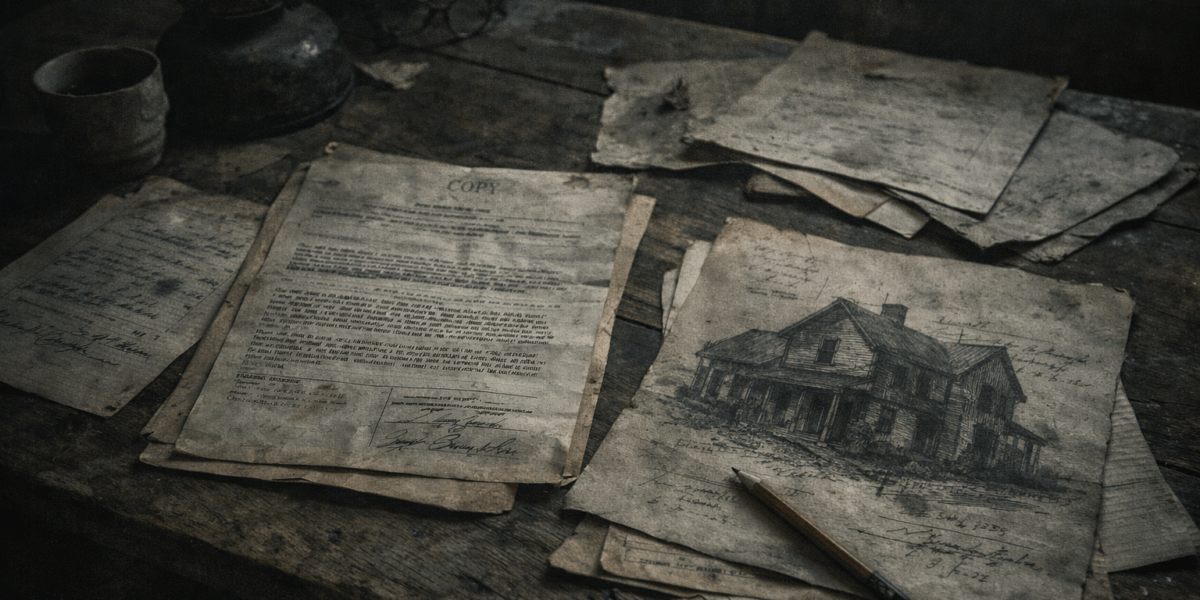
I took what I had: the realtor’s listing, the shoebox of receipts I found under the cellar stairs, and the printouts the clerk let me make from the permit index. I was looking for a reason for the thick run of wall in the front room. Chimney chase. Plumbing chase. A framed-over bump-out that got forgotten and skinned flat. I’m open to all of that if it lands clean.
The listing says 1,872 square feet. The assessor’s card from 1993 says 1,940. In 2007, a reassessment knocks it to 1,896, notes: “closets removed.” Bedroom count bounces between three and four in the same line of the file. One electrical permit from 1956: “add duplex outlet in pantry.” There is no pantry now, and if there ever was one, it would have been right where that wall swallows a few inches for itself.
Sanborn map, 1912 microfilm at the library annex: soft, grainy, but the symbols are clear enough. Brick chimney shown on the east exterior wall. My chimney sits dead center. The basement tells a different story—the fieldstone shows a vertical seam under the north parlor, a different mortar color, a fill like someone plugged something narrow and tall. No soot on the stone there. If it was a flue, it was cleaned or never used.
From the box: Wexler & Son Carpentry, October 1978. “Sister two joists NW corner dining. Re-skin lath w/ 3/8 rock.” Another line, ballpoint bled into the yellow paper: “close off void by fr rm?” The question mark is on the paper, not mine. There’s a pencil sketch on the back, square and arrows, not to any scale that helps me, with a note: “as-blt not per drwg.” I don’t have the drawing it wasn’t per.
The deed copy the Realtor gave me has the older notes typed along the margin, transcribed from something the clerk called the “big book.” Earliest line she could find: June 14, 1891 — Grant to S. & E. Blackw—. The toner clipped the rest of the surname. The chain of title after that is neat until it isn’t: a gap in the 1930s where a transfer is referenced but not attached. I asked about it; she shrugged, said things get lost when the courthouse moves, or gets wet. The county birth and death index search terminal spit back nothing for that pair of initials when I tried them there, which isn’t proof of anything except that the machine is blind to what it doesn’t have.
A 1944 survey sketch in the folder shows the same footprint I walk around in, but the interior marks are off: a closet drawn deeper than mine, a stair starting one riser earlier. One inch equals eight feet on the paper; reality doesn’t agree on the decimal.
So, sensible explanations still on the table: a chased pipe, a false corner to square a crooked beam, a fire rebuild that no one wrote down in a way that survived mildew and moves. None of the numbers line up enough to make a confident cut.
Paperwork can tell you who owned a house, not necessarily what was done inside it.
— Thomas Hale