
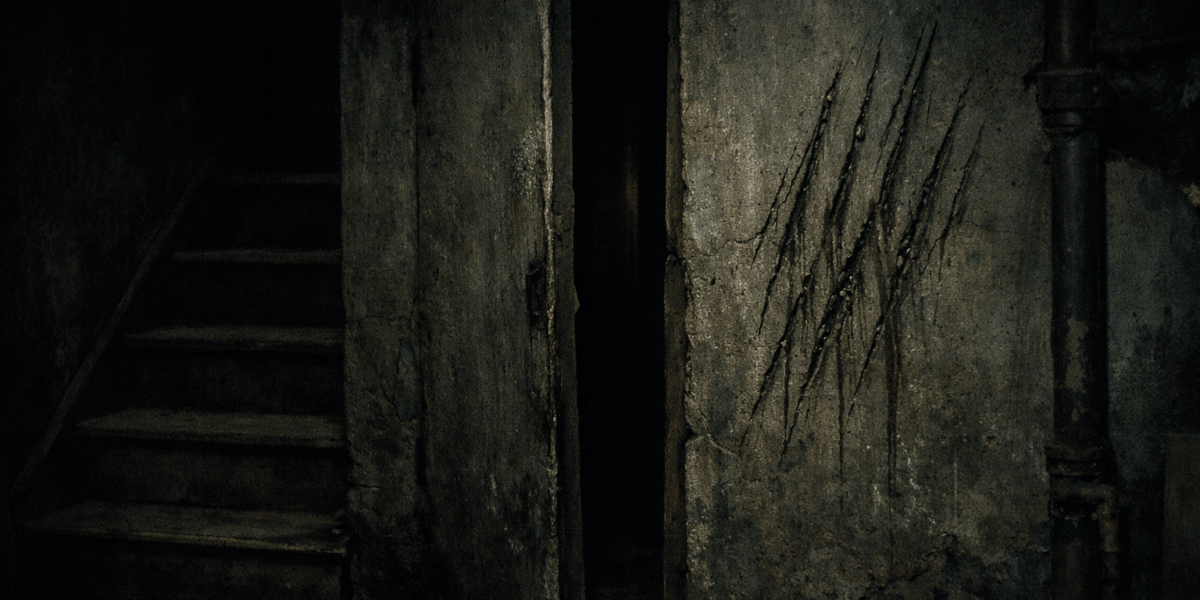
Entry #53
May 30, 2024 — 9:45 PM
I was bagging plaster from the hall, the new cut open to the studs, the LED clamped to a sawhorse throwing its flat white over the lath. The air had the old-paper smell again, a dry sweetness from the timber rubbed raw by the saw. I’d brushed the sill plate clean this afternoon and left a thin combed line in the dust along the lip, a tell. A strip of blue tape still bridged two studs where I wanted to remind myself about an out-of-plumb run. Everything exposed, nothing fancy—wood, nail heads, darkness behind.
The sound came while the bag rasped my shin: a low scrape from the left side of the opening, shallow and slow, as if something flat tested the grain and then stopped. It was followed by a single soft knock—not hollow, not padded—just the weight of wood meeting wood in a small, sure way.
I put the bag down. Two steps and I was at the cut, face almost in the opening, light slid with me. No delay, no building a scene for it. I put my palm flat against the stud that carried the sound. It was cool and steady. I watched for any shift where dust might slide down a lath edge. Nothing.
The new void looked unchanged. The chalk line I snapped across the lower lath is still faint and straight. The combed dust on the sill: unbroken teeth. Mortar crumbs at the joist pocket hang where they hung. Even the pale scratch on the near stud—the faint E, then a gap, then a vertical stroke I noticed yesterday—matched by memory. I leaned in farther and the cold in there was the same cellar-cold I’ve had since I opened it, not a gust, not a breath. I could smell the line of old mouse run somewhere deeper, dry and stale. The light did what light does: it described surfaces and stopped.
I tried to make the sound. I dragged the tip of a finish nail along a length of lath. Close, but thinner. I pressed my knuckles, light, to the stud. The knock I made had a skin to it mine didn’t. Mine belonged to my hand. The earlier one belonged to the house.
I checked the adjoining run inside the pantry. The shared wall where the plaster bulges near the baseboard had nothing to say. I held the edge of a putty knife against the stair stringer that ties in a bay over. No tremor. In the upstairs hall above this cut, the floorboards near the heat register gave me their usual short complaint when my weight moved them. That sound carries in a familiar way, thin and metallic along the duct. The one I heard did not travel; it sat still and it reached me.
Since the hollow came out into the room, the noises have changed character. They’re not louder. They are closer to the shape of an action, without the action. The house has always used sound to draw lines. It’s drawing them thicker now.
Finding nothing out of place doesn’t settle it. It makes a clean outline around a thing I can’t describe. Hearing a sound from a space already in view is worse than hearing one from darkness.
— Thomas Hale