Entry #260
January 9, 2026 — 11:30 PM
Morning light came flat through the east windows. I took the pry bar back to the braced hollow and worked the remaining lath free, one strip at a time. Behind it was not void but a built recess: a niche no deeper than my forearm, framed in by added studs that didn’t match the rest. The wood inside was dry and close-smelling, like paper left in a warm attic. I set the headlamp on the sill and made an inventory before touching anything.
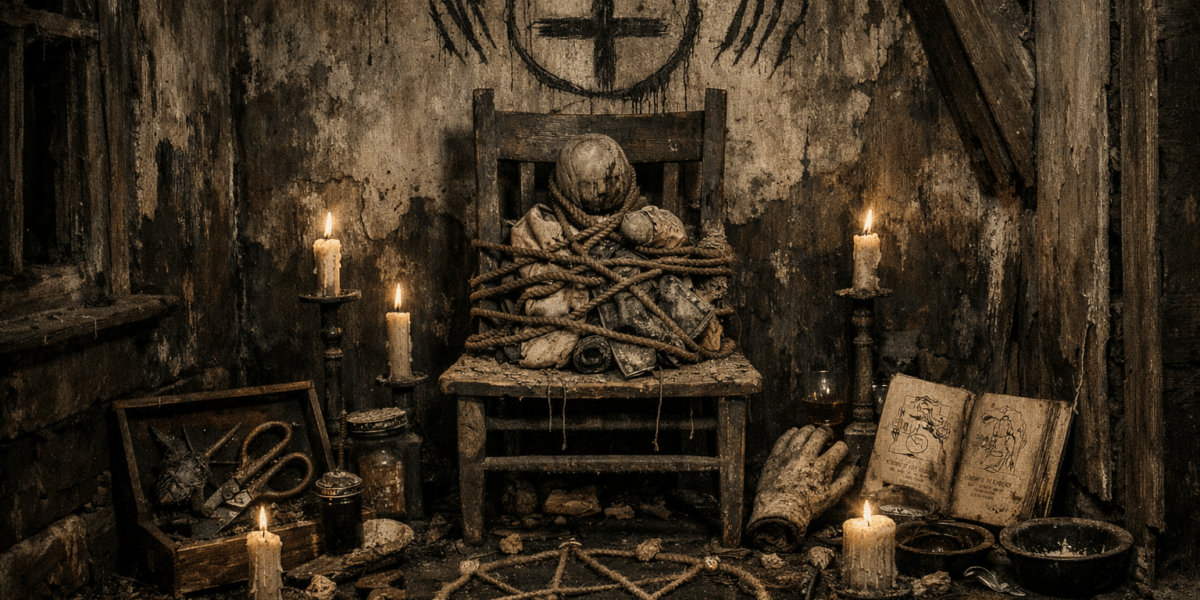
Fragments: slivers of brown wax in a dish the size of my palm, edges chipped in a way I recognize from old phonograph cylinders; three broken glass rectangles with blackened emulsion, likely plate fragments; a graphite stub in a grooved holder; a collar stay cut from celluloid; a single cloth tag, blank now, with paste residue on the back; crumbs of sealing compound along the seam where the backboard meets the studs. Under the lowest shelf, a scattering of grit that looks like scraped ink or iron-gall bloom, black until it goes green-gray at the edges.
Arrangements: nine small nails set in a perfect line along the right stile, each bearing a loop of twine knotted twice, the loops differing only in length by neat increments; four smooth river stones laid by size on the sill; on the left, three screws that are brass among otherwise steel fittings, set at shoulder height exactly; a strip of linen pinned taut across the rear, with two faint creases as if something narrow was once folded and held there, always in the same place.
Marks: light pencil rulings, parallel, an inch apart, over which are hash marks like tallies grouped in fives; arrows cut shallowly with a knife tip, pointing up at the linen strip; a rubbed-through patch where a hand would rest. Low on the right stile, almost hidden by the last loop, the letters S & E nicked in at a slant. On the sill, sanded down and then raised again by time, the start of a name: BLACKW—. Far back, on the rear board, a date so faint it took moving the beam: 1891, the 1s made with a serifed hand.
Instruction remnants: a paper strip browned to the color of tea, stuck with old paste and reading only “—mark after—”; a short typed label loose at the bottom, the ribbon weak: CLOSE, LISTEN; on the inside face of the little door I pulled free, paint-ghost letters from an earlier coat: KEEP SHUT. There is a thin bell wire, cloth-wrapped, dead now, that disappears up into the wall, with a later vinyl-insulated splice tape-wrapped over it and routed down to a toggle that has since been removed, leaving only two screw holes and a clean rectangle against the dirty plaster. On the lintel someone penciled REPLACE LATCH AFTER USE. The pencil has been retraced by two different hands.
Altered fittings: the hinge screws are not all of one era; two are slotted, two are later Phillips, and the topmost is a hex head that bites bright where a wrench slipped and took the paint. The latch plate has been reversed, then reversed back—the imprints of the screws show both positions. Beside it, a light hasp fixed at some point, small, enough for a thin lock; its twin shadow farther out means the hasp was moved inward. There are tiny screw-eyes set into the framing where no curtain would ever hang.
I am not going to claim what this is. It reads as procedure, and then as habit. The earliest hand is old ink and knife. The next is typewriter and paste. Then ballpoint. Then felt-tip. Each added without erasing the last, except where someone tried to sand a name from the sill and failed. The loops cut and retied, the latch set and reset. The bell wire spliced, then abandoned.
It suggests an original act that needed a place, and later people who kept using the place after the act was no longer new. The deed in my folder bears the names Samuel and Eleanor Blackwood, signed June 14, 1891. Their initials are here, cut small, as if by a hand testing a knife. I cannot tell if they were the first to make a record in this wall, or the first to have the wall make a record of them.
I took photographs, I bagged nothing, I closed it again. I will return with better light, a magnet, tracing paper, and time. I will keep taking down only what I can name. Understanding often begins with the proper naming of separate things.
— Thomas Hale