
Entry #261
January 10, 2026 — 12:15 AM
This afternoon I followed the chalk run from yesterday along the baseboard seam where the plaster buckles by the parlor door. The newer trim came off in clean lengths. The wood behind it turned darker, old sap bled to black. When I pried at the braced hollow under the stair, a hinge I hadn’t seen let go and the panel fell inward on my knee with a dry breath of air the temperature of a cellar.
The space was not a chase for heat. It was a narrow standing bay, shoulder to shoulder with the parlor wall, lined in tongue-and-groove hard pine rubbed to a satin by a body that stood there often. At eye level, a slit no wider than a reed had been cut through and lined with tin. With a lamp behind me, I could see the parlor molding framed on the far side. The angle of the slit was deliberate. If I squared my shoulders and set my eye, the view came out over the wainscot and fixed exactly on the little recess by the chimney breast—the binding niche from yesterday—and on the iron stubs set into its plaster face.
Below the slit, a brass mouth like the end of a trumpet pushed from the wall. When I blew dust from its bell and put my ear there, my breath ran down somewhere and came back as a faint, doubled echo. The throat of it held a taste of old metal and lamp oil. A thin cord, brittle with age, came down beside it to a porcelain knob. A test tug made something in the bones of the house answer with a muted tick. Not a call to service. A signal kept between the walls.
There was also a fold-down writing shelf on leather thongs. On its surface, the varnish had a rectangle worn matte by paper. No paper remained, only the ghost of it: carbon smeared into the grain, and the shallow relief of pressure marks. With raking light and patience I could make out headings repeated in the wood like a rubbing: Witness, Refused, Agreed, Signature Taken By, Time. Farther down, a date pressed deeper than the rest—June 14, 1891—and the friction-polished imprint of two names set side by side where the hand must have traced them again and again: S. Blackwood. E. Blackwood.
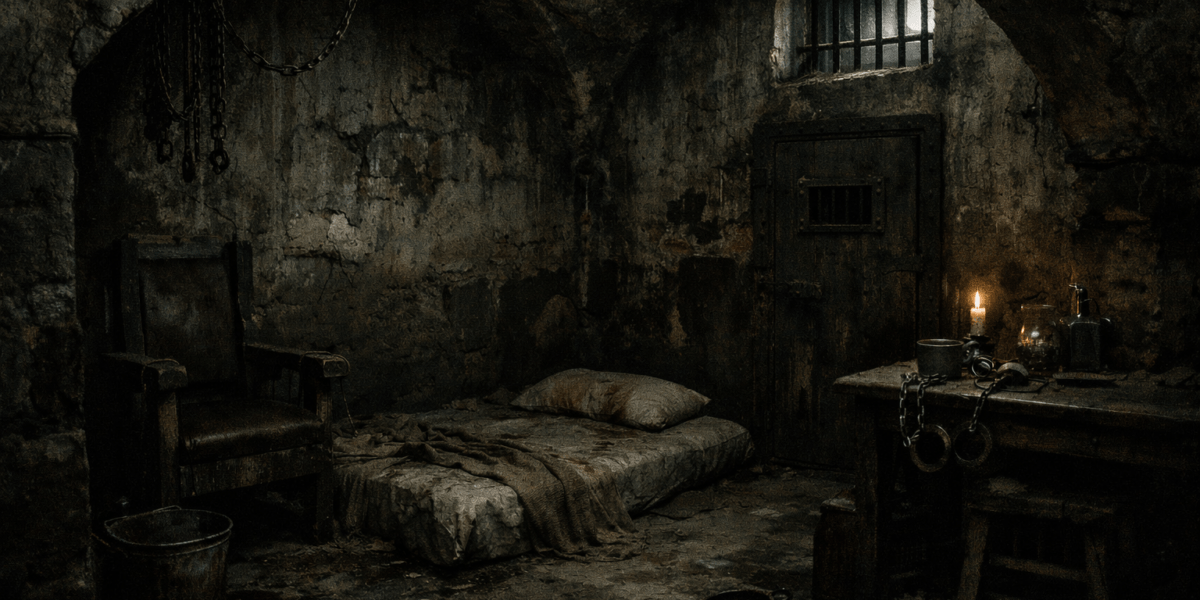
The tin-lined slit faced the iron fixtures. The speaking tube faced the mouth of the niche. The bell answered somewhere out of sight. The shelf sat where a hand could record without being seen. Across from it, I found on the niche side a second, smaller hatch disguised as a baseboard return, with a simple interior bolt and two short iron straps bedded in the studs. No blood, no stains, nothing theatrical. Just hardware and habit, arranged to confine a person, speak to them, and watch them, and to fix what happened in a place meant to hold records.
Beneath the shelf a shallow drawer held only the husks of onion-skin carbon, blue-gray sheets gone brittle. In the jamb someone had cut pale notches at finger height, grouped in fives, the wood worn smooth where a thumb might rest. On the backboard, under the shelf lip, another hand had made a list of times with a carpenter’s pencil, each followed by a check. I found later marks in a different pencil and a looser hand—1931, then nothing legible, then an initial I have seen elsewhere here, linking this to the chain of keepers who came after. The system taught itself forward because it worked.
The house’s oldest hidden work was not comfort or weathering. It was secrecy with instruments: a vantage, a voice, a restraint, and a record. Violence and witness were bound together from the start. The names Samuel and Eleanor Blackwood sit at the beginning, in the position of witness. Whether they documented this place or were documented by it, the effect is the same: the origin is culpable. The house had not learned cruelty from haunting; haunting was what remained after cruelty had become habitual.
— Thomas Hale