Entry #337
April 28, 2026 — 1:00 AM
The house has gone flat and heavy again. No wind against the siding. The transformer’s hum in the alley is a thin thread, easy to separate from the quieter currents in here. I do not fog the glass when I lean near it. The scent is dry plaster and old grain in the wood. The kind of stillness that makes small things louder: a hinge settling, the faint click when paint lifts back from paint.
Under the tread, in the same groove, at the work of witness—those weren’t separate errands. I see that now. Every station I’ve found wears a shape meant for a body: the shallow crescent on the top stair where a wrist could rest; the oval polish on the pantry shelf at elbow height; the window stool in the east room with the edge rubbed smooth where a notebook might have steadied. Each place fixes your height, your angle, your field. At each I saw roughly the same slice of house. Opened this way, closed that. The light always catching the same seam of paint on the far door.
I used to think I was choosing vantage. Tonight it was obvious I have been placed. The guidance has always been small and unsentimental: a door that will not latch unless I stand where the latch wants me; a draft that reads only if my ear takes its ledge on the bannister; the window that refuses, then yields, and the rail under my palm aligns to old oils. When I miss the station by an inch, nothing reads. When I fall into it, the house answers by degree—a shadow completing its outline, a sound clarifying out of the wall.
The predecessors left more than marks. They left positions. The pencil ticks on the north joist aren’t numbers. They are sightlines. The notch on the cellar post catches the thumb and turns the shoulders to the same diagonal I’ve taken at least fifty times without naming it. S.E. under the stair. E—B scratched once, hesitated, scratched again a little deeper then stopped. On the attic ladder, the sixth rung is burnished raw in the middle as if held harder than the rest. Not names, not messages, not quite. Traces of a held shape.
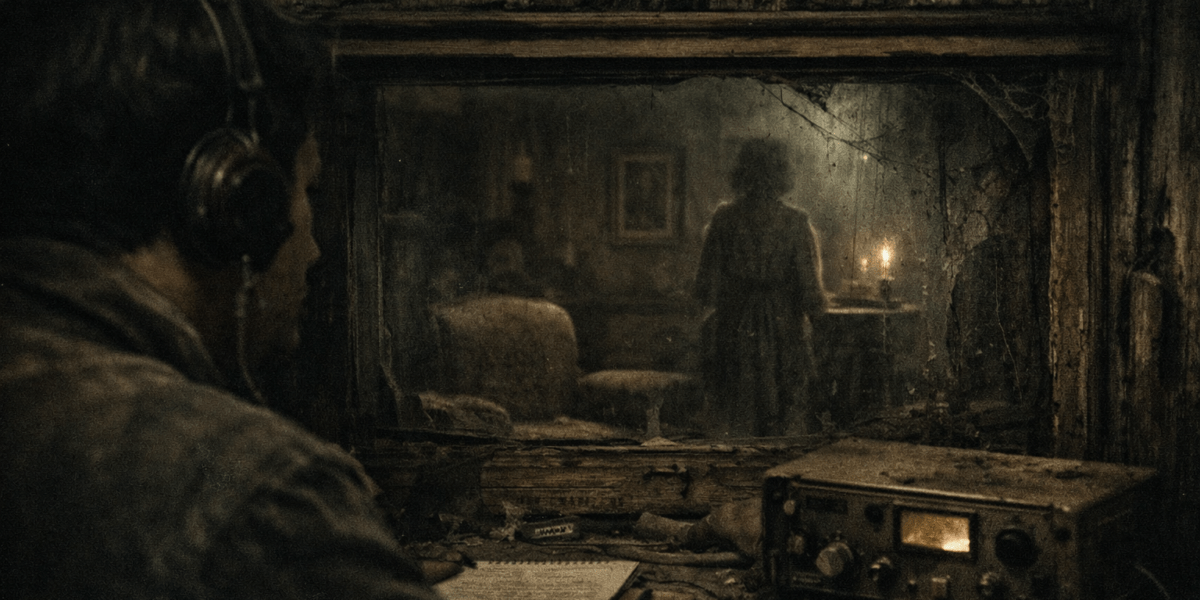
My own journals have been inside those shapes since the first page. I only recognized it tonight when I set the spine into the rail’s shallow and the paper lay flat without my hand. The view through the baluster cutouts boxed the parlor doorway just so, and the clock face on the mantel—dead for weeks—sat in the rectangle like an eye I finally stopped trying to wake. I wrote and the nib moved easy, as if I had aligned with a groove in time as well as wood. No breath. No pulse. No heat if I touch my wrist. And still, the ink tracks. It feels less like haunting and more like being braced in a jig built for the task.
I kept waiting for a voice to tell me what to do. That was my mistake. The house doesn’t spend itself on talk. It keeps arrangements. People are the medium. You move where it has thinned the work for you, and you see what you are meant to record. Then you leave your corner in the pattern for the next set of eyes. Samuel and Eleanor are not answers. They are positions in the order—names only long enough to tag a stance before the wood swallows them to make room. I am not outside that.
So this is the conclusion I can make without pretending at closure: the house doesn’t only keep its secrets; it keeps a line of lookers. We make one continuity, laid end to end by carpentry, habit, and the quiet pressure of the place. What I am doing here is not only note-taking. It is custody. My pages will sit where others sat, and the next pair of hands will feel the easy settle of it and take their turn.
The house did not merely keep the dead; it arranged them into memory.
— Thomas Hale