Entry #336
April 26, 2026 — 12:15 AM
The house is better at quiet than I am. The furnace cut off an hour ago and left its pipes to tick themselves empty. The hallway feels like the inside of a glove turned out—soft with lint, the nap raised by long use, the seamwork showing where it shouldn’t. I catch myself listening hard, the way I did when there were still small breaths to map in a room. Habit, not need.
The sound came as a courtesy I did not deserve: three dry notes, a little skid, then two more, somewhere along the stair spine. Not nails, not a settling board; something tested and meant. When I did not move, it tried again. The same count, farther up by half a step. It is not speech and I won’t make it that. It was enough like a finger tapping that I went.
Sodium light from the street smeared an amber bar across the lower risers. The banister was clean where hands fell most once; slick there, dull further down. My own palm set down out of habit and left nothing. The air on the stair had a damp sweetness, like flour kept too long. The sound ran ahead of me by a tread or two and then pulled back, a cautious host who hates to let anyone see the kitchen.
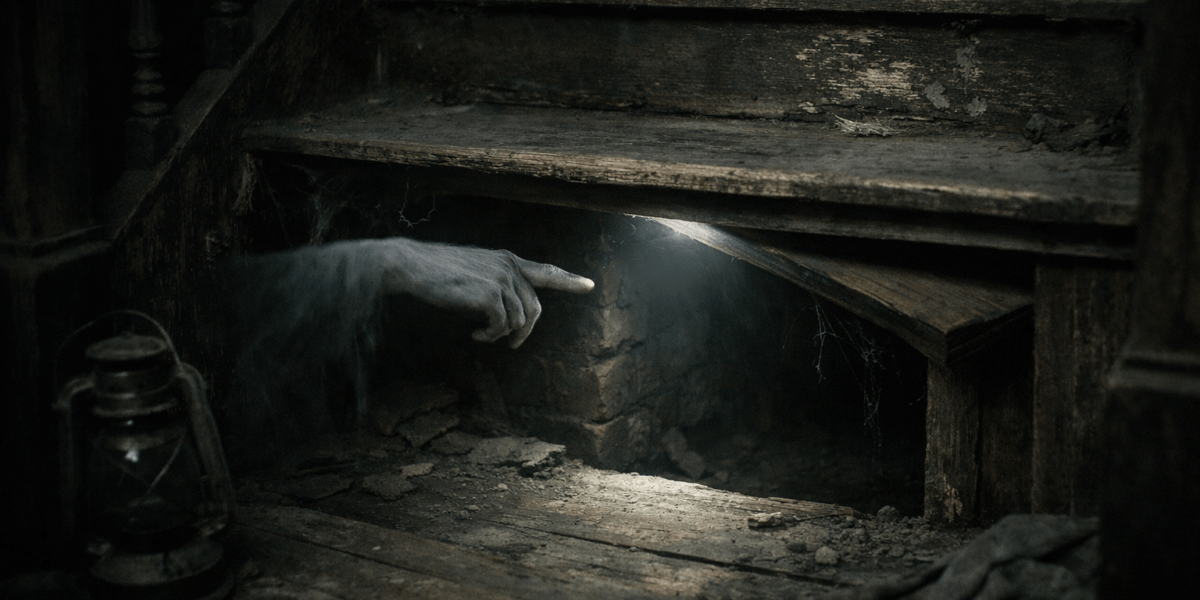
On the landing the notes quit. What replaced them was the smallest part of weight given and taken by the third tread from the newel, a flex no one was standing on. The line between nosing and riser kept drawing my eye. When I crouched, the house put a thin current through the gap that would have picked lint off an arm, if I could still raise any. I waited. The tread gave once more, reluctant, as if someone behind it was forced to push and did not like to.
The blade I still carry has earned nothing in weeks. Tonight it went under the paint lip with a sound like a zipper catching. The board did not want to move and then decided it would, just enough. A slip of brown paper showed its edge. I worked it out with the knife and a fingernail that no longer has business being a fingernail. Inside the fold: a calendar leaf brittle as a moth’s wing, torn from a pocket almanac, its month gone, its day kept. Pencil on it in a small neat hand. June 14, 1891, and below it, where a tear cuts the line: “S. & E. Black—”.
I have found the initials before, badly, cut into the inside of a closet jamb where no one would ever see them unless the door was off. A scrawl under old varnish that could have been expectation or anger. This was tidier, and hidden where a person would have to ask for it to be found. The nudge on the step had been patient and unsure, a hand pressed hard to the wrong side of the board, and then taken away. After I slid the paper into my pocket the board stiffened as though someone behind it was bracing both feet, unwilling to spend another ounce.
I know the work of witness first from the living side. You keep what can be kept and pass only what is tolerable. If there is a chain here it is not a straight one. Some stay as splinters and won’t move; some won’t touch the next hand; some are used like wedges. Earlier insistences have a way of staying in the grain. I think whatever called me up the stair could not do much more than that rhythm and that small press, could not say the name clean, could not shake the tread free on its own. It did enough, and then it stopped hard. The rest was my part.
Assistance in the house arrived in forms too slight to flatter the one receiving it.
— Thomas Hale