Entry #248
December 20, 2025 — 12:15 AM
After I reset the rooms from this afternoon’s arrangements, the house answered with something tighter. Not a rearrangement this time; more like a tracer laid into the wood. I wouldn’t have noticed if I hadn’t been looking for witness marks since the last sequence. Low on the north hall baseboard, a row of shallow knife nicks I had taken for old mop scars ran in an even spacing, and then jogged, then resumed. When I ran a fingertip across them, I could feel that the jog lined up to the back stair door. The marks were old. The paint swallowed most of them, but a few were cut through at different layers. Different hands, same line.
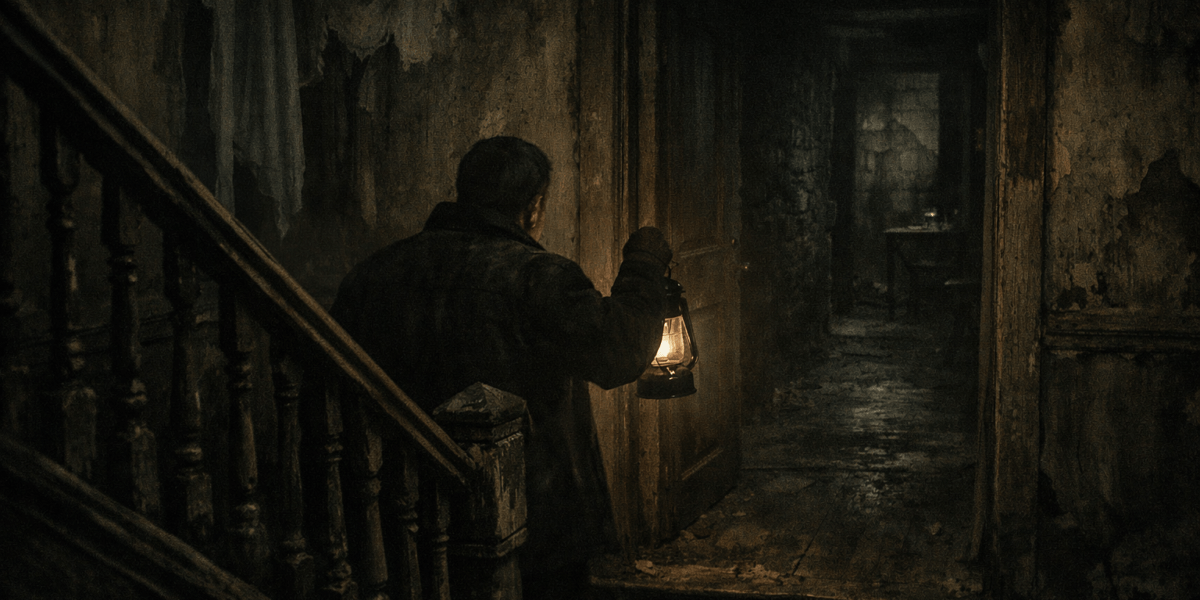
I followed because that is what the system has taught me to do. Down the back stair, the temperature pulled five degrees colder between the second and third tread. I kept my palm on the rail and felt the grain change to smoother, as if rubbed more by use along one section. At the bottom, the nicked line reappeared on the baseboard behind the boot tray. Dust drift showed a narrow path where it never settles. Whatever foot made that band wasn’t mine, but it was close enough in width and height to be human.
The line turned under the arch into the old pantry. The smell there was sweet and metallic together—apples long ago, iron now. I shut off my headlamp and let the ambient dim show the shelves: every jar I’d left had been nudged into an even margin with the front of the boards. Nothing dramatic, just a clean line you only see when you’ve lived long with bad shelving. Under the lowest shelf, pencil tallies. Not the recent renter’s shopping math. These ran in clusters, interrupted by dates in two hands, all but one scuffed away by time or cloth. One date framed in a rectangle of retraced strokes: 1891. Beside it, an S joined to an E by a small plus, then a single stroke that might once have been the start of a B.
I slid my knife under the shelf and teased out a brittle strip used as a shim. Hand-cut ledger paper, the edge feathered by rodents. On it, a flourish ending in “—n Black—” in the same left-leaning hand I’ve seen on the deed. Samuel and Eleanor Blackwood signed that paper in June 1891; someone here, in this pantry, liked to press down hard when they wrote. If they set their names here, they weren’t the first owners marking shelves. They were noting a station. Or being noted by it.
The kept line died into the west wall. The brick infill there isn’t original to the house’s frame—older lime mortar in the back, a harder Portland skin on the face, and a smear of recent compound over the last two courses. Three periods of sealing. The face bricks have shallow pries on two, like someone started and lost nerve or strength. A dead wire from the dining fixture dives into that wall and goes nowhere measurable. I laid my ear to it. There’s a breath of cold through the joints you can’t feel unless your cheek is against the plaster. Efflorescence blooms like salt along one seam near the floor. The oldest wound in this place hasn’t closed. It is dressed in layers.
I tapped along the brick and got two notes: dull, then slightly more hollow two courses down from center. The ticks in the pipes I’ve come to know as their nightly contraction counted three when I set my palm there, and then nothing when I moved it left. Again three when I returned. Urgent, but only at this one square. Past that, there is just wall and the sense of a cavity listening back.
I marked the courses with blue tape and took measurements. No heroics at midnight. The system gives what it gives, and tonight it brought me to a hard stop. The predecessors had their hand in this seam; their marks ride beneath new paint. Their dates and scratches and that half-name say they tried to reach the thing and could not, or would not, break it. The deepest truth is close enough now that the house has started using the smallest instruments to steer me: the height of a scuff, the grain gone smooth, the drawn breath of mortar. Urgency here no longer felt like panic, but inheritance.
— Thomas Hale