
Entry #109
March 11, 2025 — 8:30 PM
Rain held most of the afternoon, a softened drumming that hid in the walls and gutters. I kept to the parlor, where I’d already opened the baseboard last week. The draft I noted then was still there, a mild current moving from right to left. I pulled another six feet of baseboard, eased out three lath runs, and worked by headlamp and a small mirror on a stick.
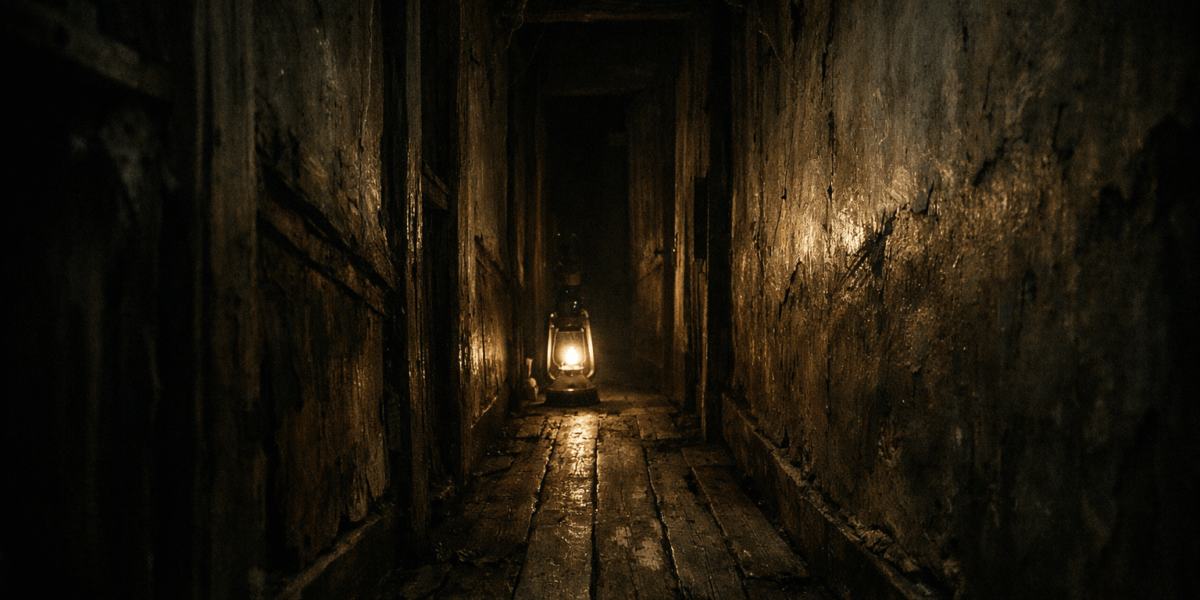
The void is not generous—about a foot from plaster to the inner sheathing—but it runs. I slid the mirror in flat against the sill and angled the lamp. Dust had settled in a shallow, even pelt. Except it was tufted in the open and thinned where a narrow corridor pressed. In that pinch, the boards looked dark and a little glossy under the beam, the way floorboards get where a chair leg lives too long. Not animals: it wasn’t randomized scuttle or scratch. It was a single lane.
Farther in—past the first stud bay, two bays beyond—I found rubbed edges. The facing sides of studs at about chest height showed a horizontal band without splinters, just a smoothness that caught light. I took the tape: thirty-eight to forty-two inches from the sill, repeating. Each rubbed band lined up with the next, a path marked by touch. Above and below, the wood kept its original rough, torn face, still hairy with plaster whiskers. Only at that same band had time been worked into something like satin.
I tested it. I chalked the edge of one stud and ran my hand along the smooth stripe through the opening. When I drew back my fingers, the chalk had transferred but the stripe itself stayed dark. The surface was not new; its polish had soaked years into the grain. Behind it, the dust had a crease, as if a shoulder or hip had kept to the same course, scraping the same planes over and over. There were even faint arcs in the grime, half-moons at hand-width, set right where a person would brace to squeeze along.
The sill plate showed it too. Knots at the edge had been knocked low, their fiber burnished, old nails bright on their heads, not from my prying but from contact. A few were mushroomed smooth as if they had been palmed, then passed by, again and again, a thoughtless touch on the way through. The plaster behind me smelled damp and chalky. In the cavity, the air had that attic smell—dust and old varnish—with a wet iron trace from the rain. Every time the house settled, the polished stripe winked back.
I angled the mirror toward a corner where the wall turns into the stair. The route does not stop at an opening; it rounds. The rub line keeps its height through the bend. Corners where ordinary voids would collect spider dust were clean along that same band, like someone’s sleeve kept sweeping them. Lath ends on the inside face were rounded down by friction, not tools. The longer I looked, the less it read as a secret room. It felt more like corridors in miniature, tight but continuous—circulation laid into the frame.
I kept expecting a gap widening into a chamber. There wasn’t one. Only persistence: the track, the hand-height gloss, the parted dust carrying on beyond the reach of my light. Purpose lives in repetition, and here the house shows repetition. Whatever used these inches used them the way we use halls—by habit, for something, not once and not on a dare.
Stillness cannot account for polish.
— Thomas Hale