Entry #338
April 30, 2026 — 2:30 AM
The house has settled into the narrow quiet that comes just before the first bird. The ducts are cool. The air is clean in that metallic way old dust gets when the temperature dips. I can hear the baseboard in the front room tick as it gives back the heat it stored yesterday. The boards under my hand have a faint nap, raised by years of damp, then dry. I waited for this hour because things hold still enough to be seen for what they are, not for what they want to be.
I accept something I kept trying to frame as a byproduct: the kept line of witness was the point. Continuity wasn’t ornament. It did work. If it were only mechanism I would have solved it at the stair with the notches and the channels and the way the house fed small facts forward like grain through a throat. But the machine stands around an absence I can’t name yet.
So the questions that remain are not about levers and means. They are these: what acts here required a witness at all, and could not stand to occur unobserved; why secrecy endured past the usefulness of hiding; and what the original core was for—the first purpose, not the later patchwork around it. The words feel heavier than the pencil, as if they fall a little into the page.
My inquiry turns now from mechanism to guilt. Not the word people paste over any discomfort, but the old thing that makes the throat close and the hand hesitate before it opens a door. The oldest moral truth sits somewhere under the footing: that the harm done wants reckoning, even if it has to conscript breath after breath to get it. That would make me not only the looker-on but the carcass it borrows to keep standing. I do not like the logic, but I see the line.
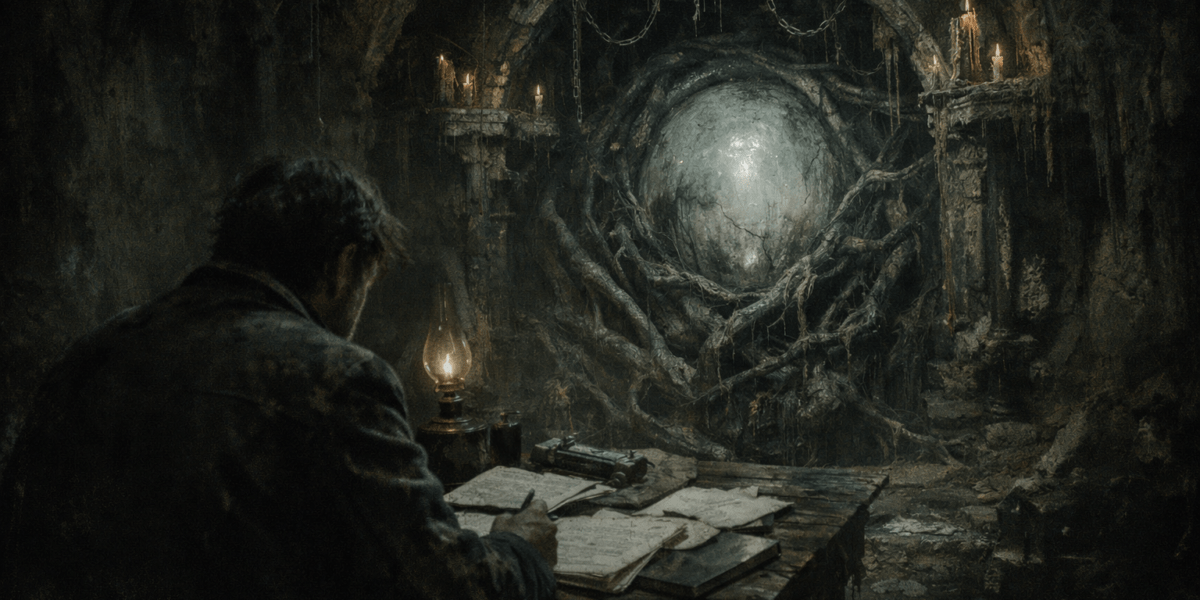
The house is ready for that kind of look. Under the middle tread, the wood shows the shallow scratches again. They are only slivers of letters, a pair paired, and a third line struck through at a later angle. The underside smells of cold sap and old ash. The space behind the riser holds air that is earth-cool and chalked with lime. I brushed my thumb across the prisms of plaster dust and it left a pale lane I can find again with no light at all.
I will go lower, and slower. Chalk in pocket to mark my path where memory can’t be trusted. Knife to lift what can be lifted without shattering the thought locked in it. Twine for the crawl, anchored to the newel, because distance is fickle down there and the house folds back on itself like cloth. I will not bring light until I have to. I want the dark at first: it keeps the breath honest. If there is a core in the foundation, it will not be a single stone with a name on it. It will be a use.
I am writing this as both witness and victim. The terms have equal pull now, and that is the only way the work has a chance to do more than repeat itself. There is a line between knowing and owning, and the next steps cross it. If there is any mercy in what comes, it will be in the plainness of what I find, not in the chance to pretend it came from somewhere else.
Mechanics can explain persistence, but not sin.
— Thomas Hale