Entry #52
May 25, 2024 — 8:30 PM
Late afternoon light came slantwise through the kitchen and reached into the gap I opened behind the pantry wall. I went back with a brush, a headlamp, a putty knife, and a small vacuum, not to clean yet, just to look without guessing. The air in there had cooled, like the inside of a cupboard that never got warm, with a faint iron taste under the usual dry wood.
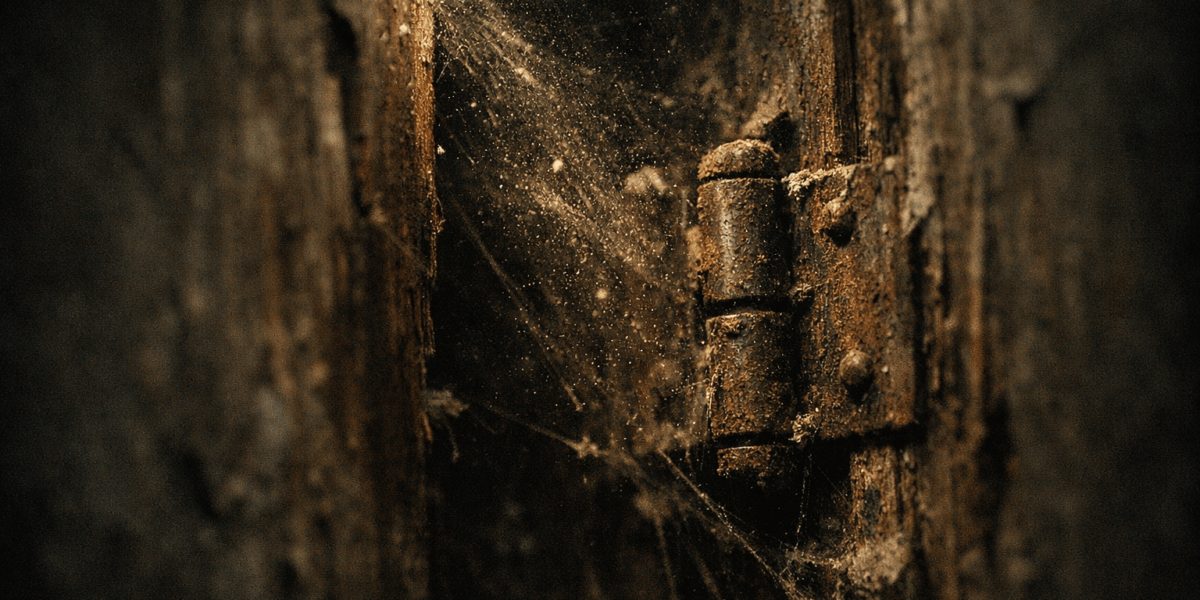
The hinges I found yesterday sit in a mortised pocket, three short leaves let into old pine. Paint climbed over them years ago, a dozen coats at least. When I swung the panel this afternoon, I watched the paint ridge along the seam. On the hinge side the paint curls are rubbed flat in a thin crescent, the wood slightly burnished where the leaf kisses the jamb. That polish does not happen in one opening. It reads like a habit. But I could have started it yesterday. I might have.
I looked closer. The hinge pins are dark except along a single line where the knuckles meet—brightened to a dull graphite color. Not new-bright, but like metal that has worked against itself more recently than the paint around it. A confounding detail: two of the screw heads show a chalky paint disk with hairline fractures radiating; one shows a small nick of bare slot where something bit in at an angle, not yesterday by me. I used a hand driver, kept it square. There is a different hand here or I am flattering my own steadiness.
Inside the cavity, the dust is not one age. Along the bottom ledge, a fur of lint and plaster grit lies even, except for a narrow channel, finger-width, curving from the panel edge to the back corner. The channel is not clean; it is compressed, grains slicked together into a darker line, like something oily passed that way and pressed the motes down rather than sweeping them aside. At the bend there are three mouse pellets, old and grey, and near them two that still have a sheen. I crushed one between paper—soft yet. Mice, then. Or a raccoon squeezing past? I checked for hair at the splinter snag. Nothing caught but a bit of pale fiber, linen or cotton, too straight for fur.
Webs tell time poorly but they tell order. In the upper right, a fan of dusty webs droops, weighty with paint powder. A single fresh strand—clear, taut—bridges from that fan to the panel edge at a point that would be parted every time the door moved. It’s intact. That suggests I did not swing it wide today until after I saw it, which is true. But the thicker filament snapped at a shallow angle across the opening has a clean end, not furred with dust. That could have been me yesterday. Or something else this week. Spiders work fast.
There is a smell along the panel edge at shoulder height, not an odor so much as a skin on the wood—grease that holds smell. My glove came away with a faint dark. I wiped a square of white card against the grain and it printed a smudge like candle soiling. Animals leave oil too, but they’d leave claw marks; the finish here is satiny from repeated touch, no visible scoring. I ran the pad of my thumb over it and felt a drag where the grain has been sealed by something the wood didn’t make.
On the inner face, in raked light, I found three shallow cuts in the soft pine, an E made by a hand that favored straight uprights, then something that could be the start of another letter or just a slip. I’ve seen that thin, insistent hand elsewhere in this house, at baseboard level in the front room. It doesn’t move the present problem forward, except that it insists the pocket was meant to be found at least once, by its maker or by someone afterward.
I am not certain what I am reading. Mice explain part of it. I could be misreading polish for age and oil for animal. The realtor would have had no reason to even tap this panel. The contractor who walked through last month didn’t notice the out-of-plane edge. Still, the neat crescent at the hinge, the compressed path in the dust, the nicked screw, the satin smear at the height where a person’s hand would go—these are not the way a sealed place stays sealed.
Abandonment leaves one kind of trace, and this was not quite that.
— Thomas Hale